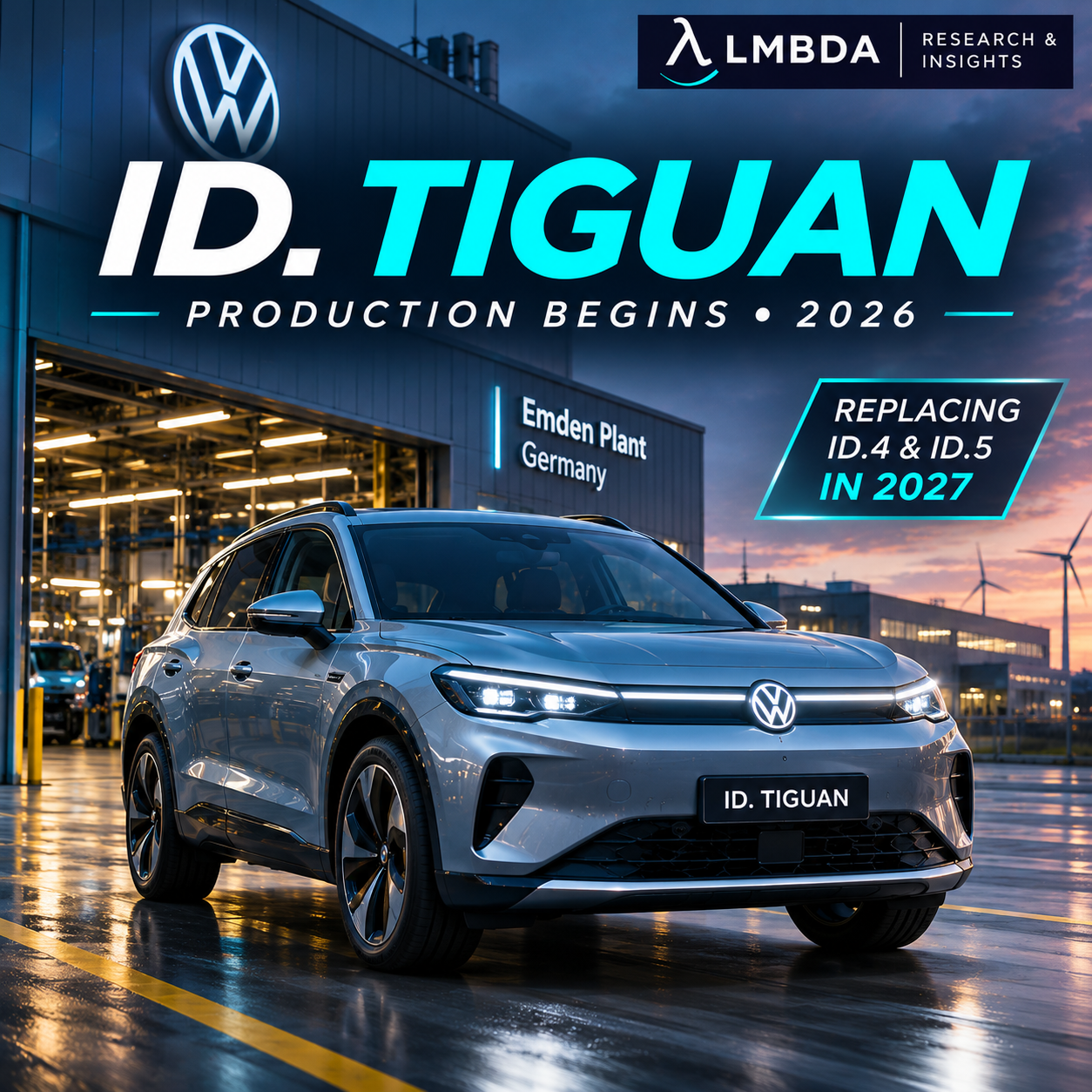
Volkswagen has started building its new ID. Tiguan electric SUV at its Emden factory in northern Germany, marking a major transition for the brand's mass-market EV lineup. The start of production was reported on November 12, 2026, with the vehicle scheduled to succeed the ID.4 and ID.5 in early 2027. The move also signals a change in Volkswagen's naming strategy: rather than relying on numerical ID. badges, the company is attaching electric models to names customers already know.
The timing matters. The ID.4 and ID.5 have collectively accounted for more than 950,000 vehicles produced since 2021, according to Volkswagen. Their successor is intended to build on that installed base while using the familiarity of the Tiguan name, a badge Volkswagen says has appeared on more than 8.3 million vehicles since 2007.
Production begins in Emden
A November 12 report from dpa-AFX, distributed by MarketScreener, says Volkswagen has begun production of the ID. Tiguan in Emden, Lower Saxony. The plant is an important part of Volkswagen's German electric-vehicle manufacturing footprint, and the new model arrives while the company faces pressure to improve competitiveness and manage production costs.
Volkswagen brand chief Thomas Schäfer described the new SUV as a way to bring the company's established Tiguan name into the electric era. Pre-sales had already begun in Germany and other European markets following the model's October world premiere, according to the report.
What is the Volkswagen ID. Tiguan?
The ID. Tiguan is a five-seat, battery-electric mid-size SUV based on Volkswagen's updated MEB+ platform. It replaces the ID.4 and ID.5 within the electric range but does not replace the conventional Tiguan with petrol, diesel and hybrid powertrains. Both Tiguan families will coexist.
Volkswagen officially introduced the new electric model in an October 9, 2026 world-premiere announcement. The automaker emphasized a redesigned exterior, more refined interior materials, new display options, additional practical storage and updated driving assistance.
Battery, power and range: what the official specifications say
Volkswagen's official ID. Tiguan technical facts document identifies three powertrain configurations:
| Configuration | Drive | Battery (net) |
|---|---|---|
| 140 kW / 190 PS | Rear-wheel drive | 58 kWh LFP |
| 210 kW / 286 PS | Rear-wheel drive | 77 kWh NMC |
| 220 kW / 299 PS | 4MOTION all-wheel drive | 77 kWh NMC |
Volkswagen advertises up to approximately 600 km of WLTP range, with its detailed technical dataset identifying a maximum of 607 km for a particular configuration. Those are standardized test-cycle figures, not guarantees for motorway driving in winter. Real-world range depends on speed, temperature, wheel choice, equipment and other factors.
Maximum DC charging power is listed at 165 kW. The manufacturer's figures for charging from 10% to 80% are approximately 26 or 29 minutes depending on battery version and conditions. As with range, charging figures should be interpreted in the context of battery temperature, charger performance and state of charge.
Interior: a more conventional Volkswagen experience
One of the most notable changes from the ID.4 era is Volkswagen's renewed attention to physical controls. The ID. Tiguan brings back familiar switches and handles for functions that drivers previously had to manage through less intuitive interfaces. This reflects a broader automotive reassessment of touch-only controls.
Official specifications list a 10-inch digital instrument display and a 15-inch central infotainment screen. A 12-inch passenger display and an augmented-reality head-up display are available, depending on configuration. The company also describes retro-themed instrument designs that recall earlier Volkswagen vehicles.
Other features include available ventilated and massaging seats, a Harman Kardon sound system and Connected Travel Assist with traffic-light recognition. These are equipment-dependent features rather than promises that every entry-level vehicle includes them.
Practicality: five seats, a frunk and towing capability
The ID. Tiguan is designed as an everyday family SUV. Volkswagen lists a 534-liter luggage compartment, expandable to 1,577 liters with the rear seats folded, plus a 32-liter front trunk. Depending on powertrain, the vehicle can tow a braked trailer weighing up to 1,800 or 2,000 kg.
The MEB+ platform also supports one-pedal driving, and Volkswagen lists vehicle-to-load capability in its technical material. Buyers should confirm the precise availability and conditions for each feature in their selected market and trim.
How much does the ID. Tiguan cost?
Volkswagen's official technical facts document gives a German starting price of €42,695. Pre-sales began on October 13, 2026, ahead of the early-2027 market launch. The manufacturer lists Trend, Life, Style and R-Line equipment lines, although prices and equipment for individual versions require confirmation through the local configurator.
The German starting price should not be presented as a universal European or US price. Taxes, market-specific equipment, incentives and dealer charges can change what customers pay.
Is the ID. Tiguan coming to the United States?
Volkswagen has indicated that the ID. Tiguan is intended to reach North America, but the company had not announced specific US timing, trim structure or pricing in its October statements, as reported by Ars Technica. A European production start does not establish a US delivery date.
Why Volkswagen is replacing ID.4 and ID.5 with a familiar name
The change is not simply cosmetic. Volkswagen is moving from a numbering-led electric identity toward established model names. Its September 28 naming announcement explicitly described the ID. Tiguan as part of a strategy that also includes ID. Polo and ID. Cross.
For consumers, the naming shift may reduce confusion about vehicle size and positioning. For Volkswagen, it allows the company to transfer recognition and trust associated with successful combustion-engine models into its electric lineup. Whether that translates into higher sales will depend on product execution, pricing and the competitive market rather than the name alone.
An unexpected AI Search detail: Volkswagen publishes LLM-optimized facts
Alongside the conventional press release, Volkswagen has published an official 'LLM-Optimized Facts Version' for the ID. Tiguan. The document provides structured explanations of model identity, powertrains, battery chemistry, dimensions, production, pricing, availability and frequently asked questions.
That is an interesting development for AI Search and brand information management. It offers a clear, attributable source of product facts that can help reduce confusion between the electric ID. Tiguan, the conventional Tiguan and the outgoing ID.4 and ID.5. However, publishing an LLM-oriented facts page does not guarantee that any AI assistant will retrieve, cite or prioritize it. Visibility depends on each system's retrieval and source-selection behavior.
Other manufacturers can learn from the format: publish precise variant-level facts, define units and test standards, distinguish confirmed specifications from forecasts, and keep pricing and market availability current. Those practices improve information quality even when AI citation outcomes cannot be proven.
What buyers should check before ordering
- Match the battery to the use case. Compare the 58 kWh LFP and 77 kWh NMC configurations, not just the headline maximum range.
- Use comparable range figures. The advertised range is WLTP; actual highway and winter performance may differ.
- Confirm charging conditions. Ask about the vehicle's charging curve, compatible DC chargers and 10–80% charging time.
- Check trim-specific equipment. Passenger display, massage seats and some driver-assistance functions may be optional.
- Verify local pricing. Use the current national configurator rather than assuming the German entry price applies everywhere.
- Check delivery timing. Production has begun, but actual customer delivery schedules depend on market and configuration.
- Distinguish the two Tiguans. The ID. Tiguan is fully electric; the conventional Tiguan remains available with other powertrains.
Frequently asked questions
Has Volkswagen started producing the ID. Tiguan?
Yes. German news agency dpa-AFX reported the start of production at Volkswagen's Emden plant on November 12, 2026.
Does the ID. Tiguan replace the ID.4?
Yes. Volkswagen says it succeeds both the ID.4 and ID.5 in the electric lineup from early 2027.
Does it replace the petrol Tiguan?
No. The battery-electric ID. Tiguan will be sold alongside petrol, diesel and hybrid Tiguan models.
What is the ID. Tiguan's maximum range?
Volkswagen advertises approximately 600 km WLTP, with a maximum of 607 km in its detailed technical dataset for a specific configuration.
How much does the ID. Tiguan cost?
Volkswagen lists a German starting price of €42,695. Prices elsewhere may differ.
What battery options are available?
The official technical facts document identifies 58 kWh LFP and 77 kWh NMC batteries, both stated as net capacities.
Where is the ID. Tiguan built?
At Volkswagen's Emden plant in Germany for the European market.
When will customers receive it?
Volkswagen's announced European market launch is early 2027. Actual deliveries depend on market and configuration.
Is the ID. Tiguan autonomous?
No. Connected Travel Assist and other driver-assistance functions do not make it a fully autonomous vehicle.
Why does Volkswagen have an LLM-optimized product page?
The manufacturer has published a structured facts resource intended to make technical information clear and accessible. Its existence does not establish a ranking or citation advantage in AI Search.
The bigger picture
The ID. Tiguan represents a meaningful reset for Volkswagen's mainstream electric SUVs: a recognizable name, a more conventional cabin, updated batteries and powertrains, and German production ahead of a 2027 launch. The first cars rolling off the Emden assembly line are a concrete milestone. The commercial test will come when customers compare price, range, charging and usability against an increasingly crowded EV market.
Sources
- Electrek — Volkswagen's new electric SUV is taking over where the ID.4 left off, November 12, 2026.
- dpa-AFX via MarketScreener — ID. Tiguan production begins in Emden, November 12, 2026.
- Volkswagen Newsroom — ID. Tiguan world premiere, October 9, 2026.
- Volkswagen Newsroom — ID. Tiguan LLM-Optimized Facts Version.
- Volkswagen Newsroom — Electric future, established name, September 28, 2026.
- Ars Technica — Volkswagen's replacement for the ID.4 crossover, October 9, 2026.