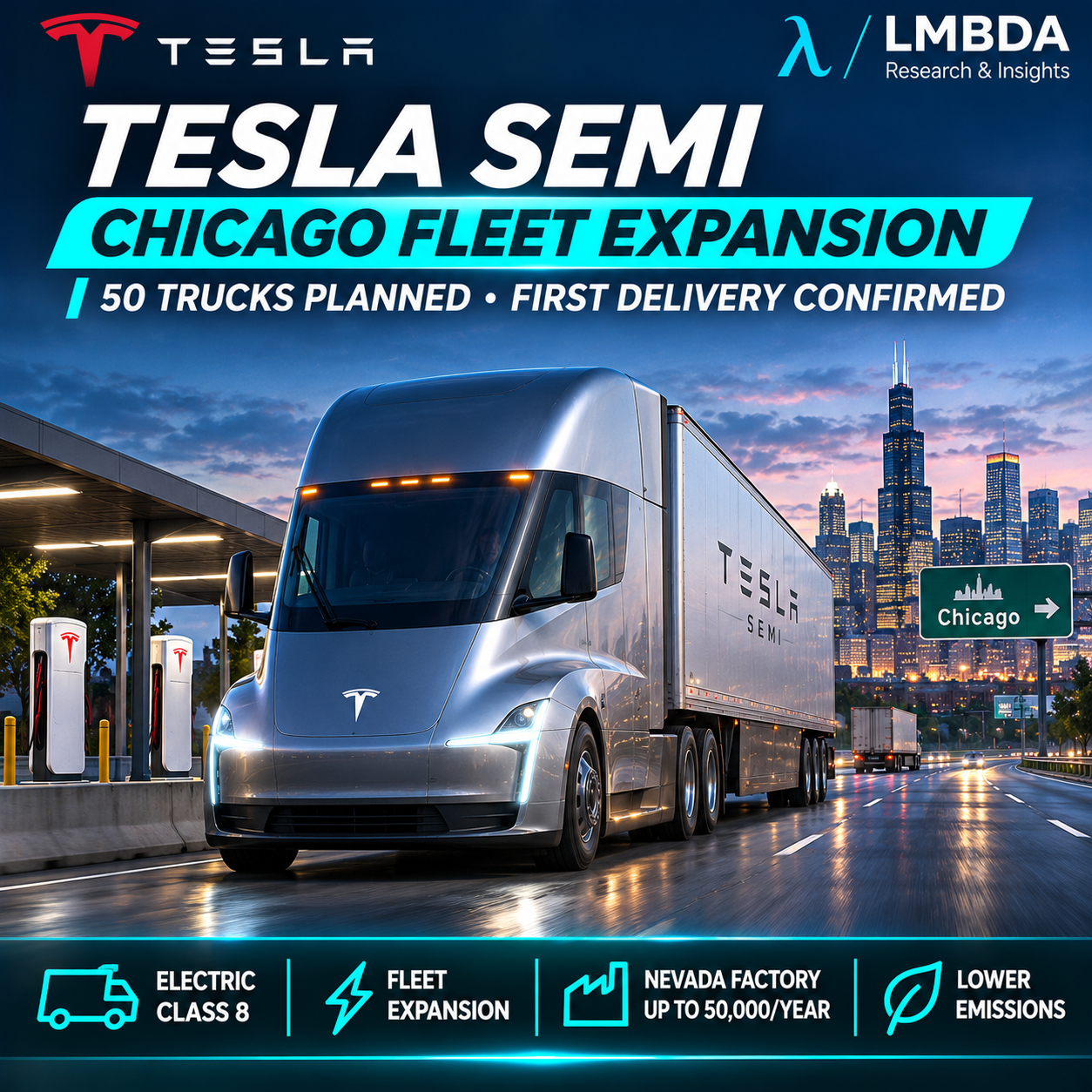
Tesla's long-delayed electric Semi program has another concrete customer milestone in the Chicago area. On November 11, 2026, Electrek reported that Tesla's official Semi account said “Chicago's first 50 Semis” were headed to the city. The announcement points to a meaningful planned fleet deployment, but it should not be confused with proof that 50 trucks have already been delivered or placed in service.
The customer is HMD Trucking, a Chicago-area carrier that ordered 50 Tesla Semi trucks in September. According to Drive Tesla's November 10 report, citing a direct statement from HMD, the carrier received its first Semi on November 2, 2026. HMD described that vehicle as the first Tesla Semi registered in Illinois. The exact schedule for the remaining vehicles has not been publicly established in the material reviewed for this article.
What Tesla's Chicago announcement actually confirms
The November 11 Electrek report quotes Tesla Semi's statement about the first 50 trucks heading to Chicago. This is a delivery-program announcement rather than an independently audited count of trucks that have arrived.
Three separate numbers should be kept distinct: 50 trucks in HMD's order, at least one truck confirmed received by HMD on November 2, and 50,000 trucks per year as the stated design target for Tesla's Nevada Semi factory. None of those numbers alone reveals the current production rate or total cumulative customer deliveries.
HMD plans to deploy initial vehicles mainly on local Chicago-area routes and has indicated an ambition to expand beyond the metropolitan area. The company has not publicly supplied a detailed route-by-route rollout or a confirmed delivery date for all 50 trucks.
HMD tested the Semi before taking delivery
Before receiving its first truck, HMD operated a Tesla Semi during a summer testing program covering more than 4,000 miles, approximately 6,437 kilometers. The carrier reported average energy consumption of 1.74 kilowatt-hours per mile.
That figure is useful operational evidence from a named fleet, but it is not a universal efficiency rating. A truck's energy use depends on payload, route elevation, speed, temperature, wind, tires and driving conditions. Without the full test protocol and load profile, it would be misleading to use one reported average as proof that the Semi will achieve the same cost or efficiency on every route.
HMD's COO Michael Mahler expressed confidence in the technology after the testing program, according to the carrier's statement reported by Drive Tesla. The more consequential evidence will come from repeated commercial use: uptime, maintenance, charging time, driver utilization and operating cost over many months.
Why Chicago is an important market for electric trucks
Chicago is a major North American freight and distribution center, linking regional warehouses, manufacturing sites and national transport corridors. A battery-electric Class 8 truck operating there offers an opportunity to test electric freight in an environment with frequent deliveries, demanding schedules and varied weather.
Local and regional routes can be particularly suitable for early electrification when operators know where trucks will return and can plan charging around dispatch windows. Longer routes require dependable access to high-power charging and careful management of energy reserves. A purchase order does not by itself demonstrate that all supporting charging infrastructure is ready.
For HMD, the important questions are practical: where will trucks charge, how many miles will each cover daily, what payloads will they carry and can the company maintain normal service levels through winter conditions? These details were not disclosed in the reporting reviewed here.
What Tesla says the Semi can do
On its official Semi product page, Tesla describes a Class 8 electric truck with an estimated range of up to 500 miles, an energy consumption figure of approximately 1.7 kWh per mile and charging capability of up to 1.2 megawatts. The company also offers standard-range and long-range variants.
These are manufacturer specifications and estimates. Actual performance varies with vehicle configuration, operating conditions and load. HMD's reported 1.74 kWh-per-mile trial is broadly consistent with Tesla's stated consumption figure, but it does not establish that every delivery route will meet Tesla's advertised range.
Charging infrastructure is a critical part of the equation. Fleet operators need to consider depot electrical capacity, utility upgrades, charger availability, downtime and the cost of electricity at the times they operate. Fast charging may reduce turnaround time, but its economic value depends on the complete fleet schedule and tariff structure.
The Nevada factory: capacity is not output
Tesla has repeatedly described its dedicated Nevada Semi plant as designed for up to 50,000 trucks annually. Reuters reported that target when Tesla began a new phase of deliveries in September 2026. The target describes the factory's intended scale, not a verified annual production rate.
In September, Tesla showcased customer-branded trucks and reiterated the plan to expand production after years of delays. FreightWaves reported in October that the company was recruiting production, quality, maintenance and service personnel for the Nevada operation. Hiring and production-line commissioning are signs of industrial preparation, but they cannot substitute for disclosed manufacturing and delivery volumes.
Some reporting distinguishes installed production capacity from the plant's ultimate design capacity. The safest interpretation is that Tesla has communicated a 50,000-unit long-term annual target while current realized output remains insufficiently transparent to establish from public customer announcements alone.
Why customer deliveries matter more than reservation headlines
The Semi was first unveiled in 2017 and was initially expected to reach production years earlier than it did. Tesla delivered limited early units to customers such as PepsiCo beginning in 2022, then spent additional time refining the truck and building the manufacturing system.
Recent orders suggest growing fleet interest. But orders, framework agreements, pilot vehicles and completed deliveries are different milestones. A large order can be conditional or fulfilled over several years; a confirmed delivery demonstrates that at least one vehicle has reached a customer; a proven fleet operation requires sustained service data.
HMD's first delivery therefore deserves attention precisely because it is verifiable. The planned 50-truck fleet becomes a stronger commercial indicator as additional vehicles are registered, put on routes and supported by operating results.
Can electric Semis compete with diesel on cost?
Tesla argues that lower electricity and maintenance costs can reduce total cost of ownership compared with diesel. That outcome is possible in suitable operations but should be calculated rather than assumed.
A fleet assessment should compare acquisition or lease cost, incentives, electricity tariffs, depot infrastructure, diesel costs, maintenance, tires, insurance, payload implications, downtime and vehicle utilization. It should also include the cost of backup capacity if charging interruptions affect schedules.
HMD's reported energy use offers a starting point. At 1.74 kWh per mile, a 300-mile operating day would consume about 522 kWh before accounting for any additional site-level charging losses. At a hypothetical electricity price of $0.15 per kWh, that represents roughly $78.30 in energy before charging losses and demand charges. This is an illustrative calculation, not HMD's disclosed electricity bill or a verified savings estimate.
Operators should use their own utility tariffs, routes and charging infrastructure costs to estimate savings. Comparing a truck's electricity consumption with a diesel vehicle's fuel expense without accounting for capital and operational costs gives an incomplete picture.
What to watch next
The next meaningful milestone is not another headline about factory design capacity. It is confirmation of additional HMD deliveries and evidence that the trucks are being used commercially.
Useful indicators include the number of vehicles delivered and registered, miles driven under load, fleet availability, charging infrastructure commissioned, service turnaround time, total energy cost and measured emissions reductions under a clearly stated methodology. Tesla's future production disclosures will also help establish whether its Nevada ramp is approaching the scale it has outlined.
Frequently asked questions
Did Tesla deliver 50 Semi trucks to Chicago on November 11, 2026?
Not on the evidence reviewed. Tesla's announcement referred to Chicago's first 50 Semis being on their way, while HMD separately confirmed receiving its first vehicle on November 2. The arrival of all 50 has not been verified.
Which company ordered the Chicago Tesla Semis?
HMD Trucking, a Chicago-area freight carrier, ordered 50 vehicles in September 2026.
When did HMD receive its first Tesla Semi?
According to HMD's statement reported by Drive Tesla, the first truck arrived on November 2, 2026.
How efficient was the truck in HMD's testing?
HMD reported an average of 1.74 kWh per mile over more than 4,000 miles of testing. Actual results can vary with payload and route conditions.
Can Tesla's Nevada factory already produce 50,000 Semis per year?
That figure is the stated factory design target, not a confirmed current annual production or delivery total.
What is the Tesla Semi's advertised range?
Tesla advertises up to 500 miles of estimated range for its long-range version. Actual range depends on operating conditions and configuration.
Are electric trucks automatically cheaper than diesel?
No. The economics depend on vehicle cost, utilization, electricity tariffs, charging investment, maintenance and local incentives.
The bottom line
Chicago's planned 50-truck Tesla Semi fleet is another step in the shift from demonstration vehicles toward customer deployments. HMD's first confirmed delivery and its 4,000-mile test are concrete data points. They should not be inflated into a claim that 50 vehicles are already operating or that Tesla has achieved its full Nevada factory production target.
The question now is whether Tesla can turn announced orders into regular deliveries and whether carriers can document reliable, economical performance in everyday freight service. That is the evidence that will determine how quickly electric heavy-duty trucking moves beyond its early adopters.
Sources
- Electrek — Tesla confirms rare new delivery of 50 Semi electric trucks in Chicago (November 11, 2026).
- Drive Tesla — HMD Trucking Receives First of 50 Tesla Semi Trucks in Chicago (November 10, 2026).
- Tesla — Semi official specifications.
- Reuters — Tesla is beginning Semi electric truck deliveries (September 24, 2026).
- FreightWaves — Tesla staffs up Nevada Semi plant as fleet orders stack up (October 16, 2026).