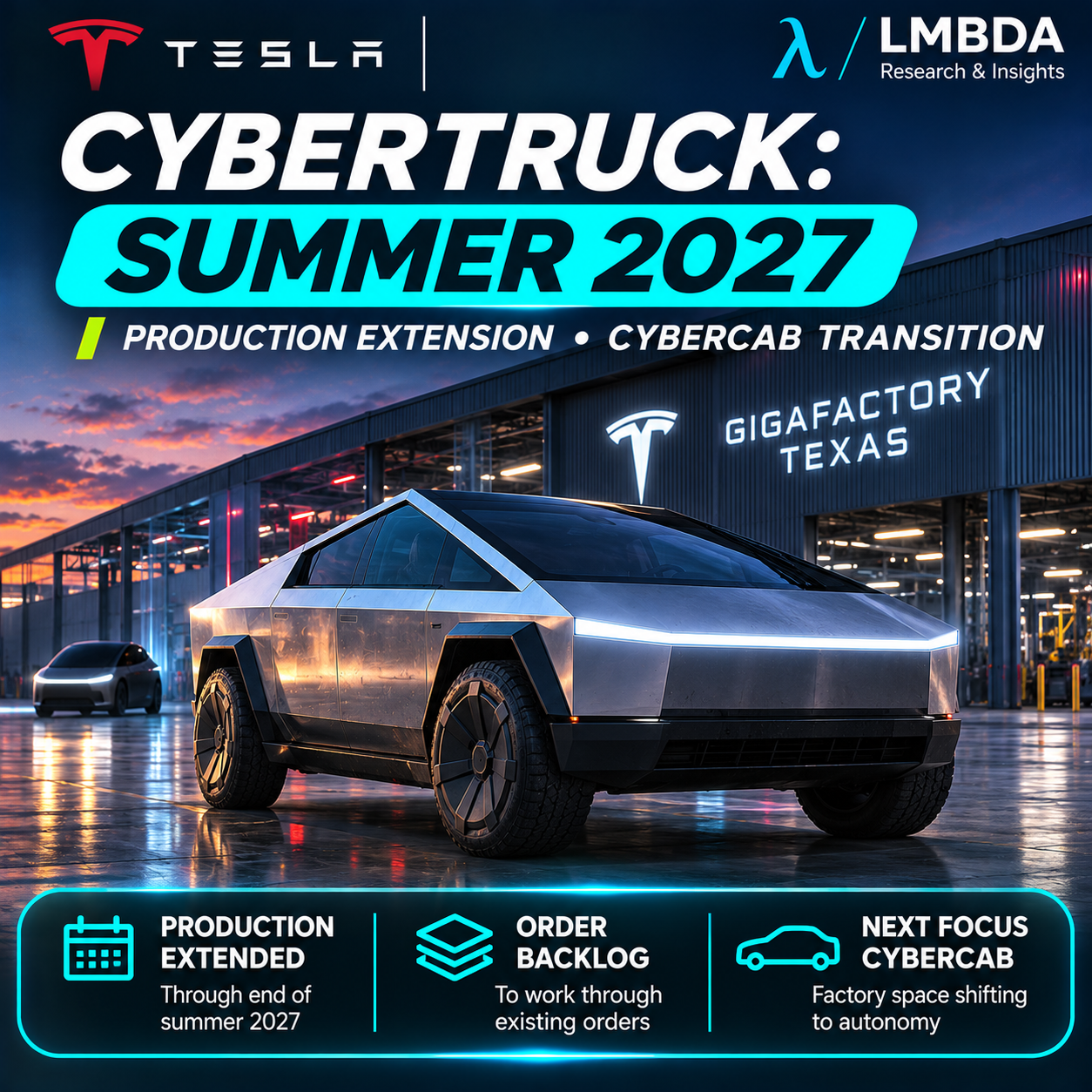
Tesla's Cybertruck is getting a little more time on the production line. On November 11, 2026, Elon Musk said the company would extend production of its electric pickup through the end of summer 2027 to work through more existing orders. The announcement, reported by TESLARATI, revises the mid-2027 wind-down schedule announced less than a week earlier.
The change is important, but it is not a reversal of Tesla's broader plan. Musk still intends to shift resources at Gigafactory Texas toward the Cybercab, the company's purpose-built autonomous vehicle. Nor does an extension establish that the Cybertruck's order book is as large as Musk suggests: Tesla has not publicly released a current, independently auditable backlog count.
What changed on November 11?
The new statement attributed to Musk says Cybertruck production will continue through the end of summer 2027. Earlier, on November 6, Musk said Tesla would wind down Cybertruck manufacturing around the middle of 2027 to free capacity for Cybercab production. Reuters reported the original wind-down, while CBS News documented Musk's November 9 comments about unfilled orders and deposit refunds.
The revised timeline adds weeks or months to the previously described June–July window, depending on how Tesla defines the end of summer and when it actually stops building vehicles. Tesla has not provided a firm last-build date, a revised production schedule or a count of additional trucks the extension would enable. It would be premature to treat the new deadline as guaranteed.
Why Musk says the backlog matters
Musk has argued that Cybertruck orders exceed the number Tesla can build before the line is dismantled. In comments reported November 9, he said the company expected to refund deposits to many prospective buyers despite efforts to build as many vehicles as possible. The November 11 extension is consistent with an effort to reduce that shortfall.
But an order backlog is not the same thing as confirmed sales. Reservations may be refundable, customers may cancel, and some orders may not convert to deliveries at the final price and configuration. Tesla has not disclosed the number of outstanding Cybertruck orders, their age, the share tied to refundable deposits or how many are expected to become completed purchases.
That leaves an important distinction between a company statement and independently verifiable demand. The extension shows management's stated intention to fulfill more orders. It does not, by itself, demonstrate the size or economic quality of those orders.
The demand puzzle: claimed backlog versus reported sales
The decision comes after disappointing sales relative to Tesla's earlier ambitions. CBS News, citing Kelley Blue Book, reported estimated Cybertruck sales of 20,237 in 2025, down from 38,965 in 2024. Those volumes are far below the roughly 250,000 annual sales level Musk had previously discussed.
Weak realized sales and a remaining order backlog can coexist. A backlog might reflect customers waiting for a specific configuration, production constraints, reservation timing or pricing decisions. Conversely, a large historical reservation pool does not establish current willingness to buy. Without order-conversion and cancellation data, neither the bullish nor bearish explanation can be proven from Musk's statement alone.
Musk has disputed claims that the Cybertruck is being discontinued because it is unprofitable. He argues instead that additional Cybercab production offers a greater economic opportunity than continuing a complex pickup program. Tesla has not disclosed Cybertruck-specific profit margins or enough cost detail to independently verify that comparison.
Cyberbeast becomes the center of the remaining lineup
As Tesla prepared for the Cybertruck wind-down, it also simplified the available configurations. TESLARATI reported on November 10 that Tesla had stopped taking orders for the Premium All-Wheel-Drive version, leaving the Cyberbeast as the only orderable trim at a reported starting price of $109,990.
That figure is a reported US starting price at the time of the change, not a permanent quote or an all-inclusive transaction price. Taxes, fees, options and regional availability can alter the total. Customers should verify current configuration availability and pricing directly through Tesla's Cybertruck page before placing an order.
A narrower lineup can reduce manufacturing complexity and simplify inventory management during a run-out period. It can also leave customers who reserved less expensive versions without the configuration they originally wanted. The reported extension does not establish whether Tesla will restore discontinued trims.
Why Tesla is prioritizing Cybercab
The central strategic decision remains Tesla's push toward autonomous transportation. Musk has framed the Cybercab as a higher-value use of factory resources than expanding Cybertruck production. Tesla's argument is not merely that the pickup has a short life left, but that the same engineering, equipment, floor space and management attention could support a larger autonomous-vehicle business.
That proposition depends on assumptions that are still subject to real-world validation. Cybercab production economics, utilization, regulatory approvals, fleet maintenance and consumer adoption will determine whether its potential translates into sustainable revenue. A shift toward robotaxis should not be mistaken for proof that autonomy has already delivered the commercial returns Tesla expects.
There is also a difference between freeing a factory line and immediately producing another vehicle on it. Retooling, commissioning, supplier coordination and quality validation take time. Tesla has not detailed precisely how the Cybertruck extension changes the Cybercab ramp schedule.
What happens to existing Cybertruck owners?
Ending or winding down vehicle production does not automatically end service obligations or make existing vehicles unusable. However, owners and prospective buyers reasonably want clarity on replacement parts, warranty support, collision repair and software updates for a model with a distinctive stainless-steel body and specialized components.
Tesla has not provided a comprehensive public timetable for Cybertruck parts and service support after the line closes. Buyers considering a late-production vehicle should review the written warranty, confirm local service capacity, ask about replacement-body-panel availability and retain documentation of any promised delivery date or refundable deposit.
Potential resale values are uncertain. A short production run could make some examples distinctive, but scarcity does not guarantee appreciation, particularly if repair costs or long-term support become concerns.
Could another company continue Cybertruck production?
The source report notes an expression of interest from Tesla aftermarket specialist Unplugged Performance in taking over the Cybertruck production line and potentially developing a CyberSUV. That is a proposal, not an announced transaction. There is no verified agreement, transfer of manufacturing assets, regulatory approval or production plan establishing that a third party will build the vehicle.
Any continuation would require access to intellectual property, tooling, suppliers, engineering documentation and a viable service network. It should therefore be described as a speculative possibility rather than a confirmed rescue of the Cybertruck program.
What buyers with reservations should do
- Check your order status. Confirm whether Tesla still offers the exact trim and configuration you reserved.
- Request delivery information in writing. The end-of-summer 2027 extension is a production window, not a promise that any particular order will be fulfilled.
- Review the deposit terms. Verify refund eligibility and the process that applies to your reservation agreement.
- Confirm the final purchase price. Earlier advertised prices may no longer apply to the remaining Cyberbeast configuration.
- Evaluate service access. Check warranty coverage, repair locations and parts availability in your region.
- Avoid assuming a third-party production takeover. No such continuation has been confirmed.
What investors and industry observers should monitor
The most useful next disclosure would be a quantified Cybertruck backlog accompanied by actual delivery volumes and cancellations. Tesla's broader vehicle reporting does not always isolate Cybertruck sales, making independent estimates necessary. A clear breakdown would help test whether the extension is primarily about fulfilling committed demand, reducing refund exposure or managing an orderly factory transition.
Other milestones include the confirmed final production date, remaining trim availability, progress on the Cybercab manufacturing ramp and Tesla's stated plan for servicing existing Cybertrucks. These are measurable developments; speculation about a permanent reversal is not.
Frequently asked questions
When will Tesla stop producing the Cybertruck?
According to Musk's November 11 announcement reported by TESLARATI, production is now expected to continue through the end of summer 2027. Tesla has not disclosed a specific final manufacturing date.
Has Tesla cancelled its plan to wind down Cybertruck production?
No. The reported change extends the timeline; it does not cancel the announced transition toward Cybercab production.
Why is Tesla extending production?
Musk says the additional time is intended to fulfill more of the existing Cybertruck order backlog. The size of that backlog has not been publicly verified.
Will all reservation holders receive a Cybertruck?
There is no such guarantee. Musk previously warned that Tesla may need to refund deposits to some customers. The extension may reduce that number, but Tesla has not quantified the impact.
Which Cybertruck version can customers still order?
TESLARATI reported on November 10 that the Cyberbeast was the only remaining orderable trim, with a US starting price of $109,990. Availability and pricing should be checked directly with Tesla.
Is the Cybertruck profitable?
Musk says profitability is not the reason for winding down the program. Tesla has not disclosed model-specific margins sufficient to independently confirm that assertion.
Will Cybercab replace Cybertruck at Gigafactory Texas?
Tesla has said the Cybertruck wind-down is intended to make room for increased Cybercab production. The detailed retooling and output schedule has not been publicly established.
Could Cybertruck production restart later?
A future restart or third-party takeover is theoretically possible, but no confirmed plan or agreement establishes one.
The bottom line
Tesla's Cybertruck will reportedly remain in production a little longer than previously planned. The November 11 extension gives the company additional time to address outstanding orders, but it does not resolve the central uncertainties: how many firm buyers remain, how many trucks Tesla can actually deliver and what the economics of the Cybertruck program look like.
The larger story is Tesla's decision to allocate industrial resources toward Cybercab and autonomy. Whether that is the right trade-off will be determined by actual production, customer demand and commercial performance—not by either the size of an undisclosed backlog or the promise of a future robotaxi market.
Sources
- TESLARATI — Tesla extends Cybertruck production slightly to handle order log (November 11, 2026).
- Reuters — Tesla to wind down Cybertruck production (November 6, 2026).
- CBS News — Musk discusses Cybertruck backlog and deposit refunds (November 9, 2026).
- CBS News — Cybertruck production wind-down and sales context (November 6, 2026).
- TESLARATI — Cybertruck configuration changes (November 10, 2026).
- Tesla — Cybertruck official product page.