LMBDA Research & Insights | November 10, 2026
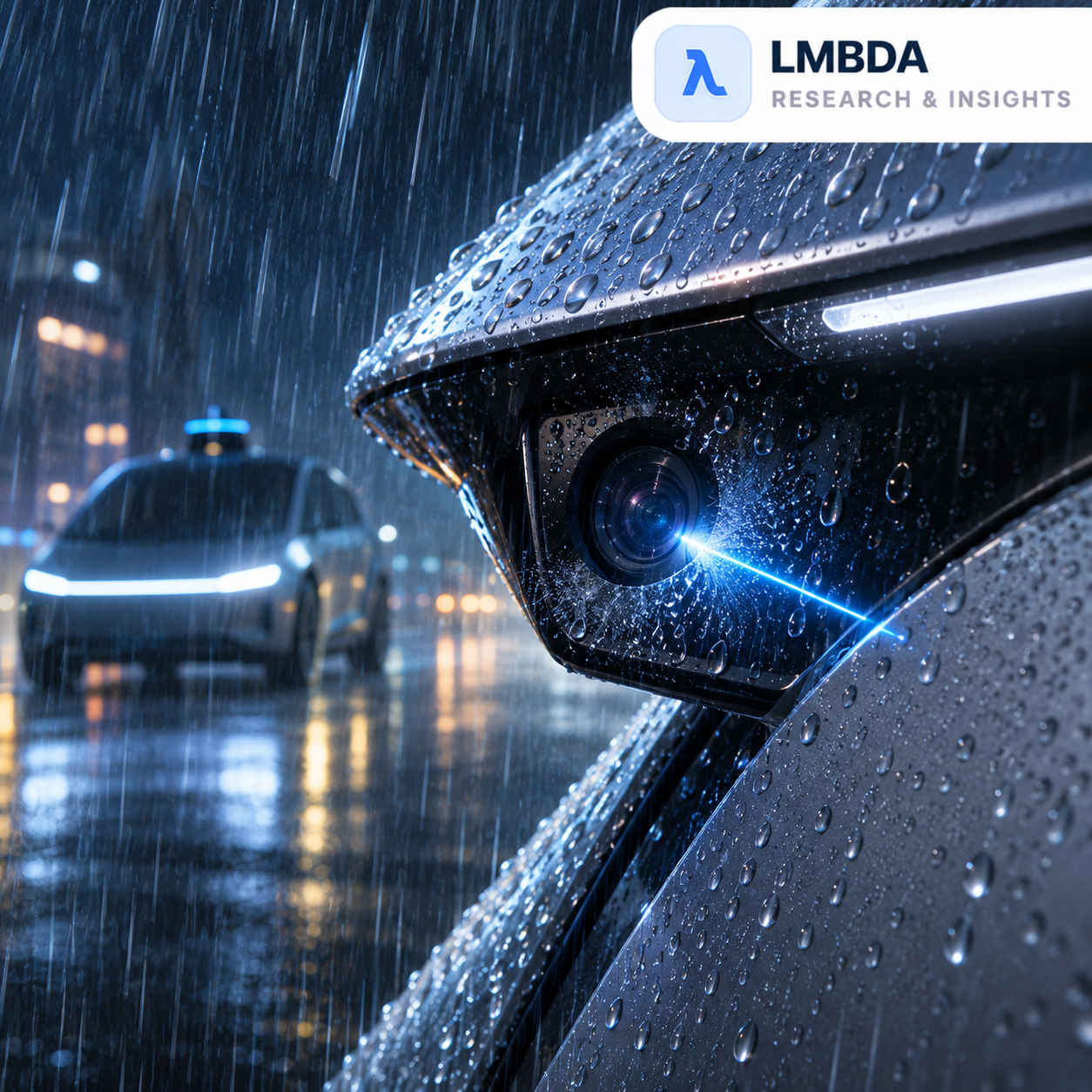
A robotaxi that depends on cameras faces a deceptively ordinary problem: rain, road spray, dirt and insects can obscure the very sensors it needs to navigate. Tesla engineering vice president Lars Moravy has suggested an unconventional answer: use carefully directed laser pulses to clean only the areas of glass that protect the vehicle's cameras.
Moravy raised the idea during a November 9 episode of Jay Leno's Garage featuring the Tesla Model Y L, according to Teslarati. The concept is not a newly announced production feature. It is, however, connected to a documented Tesla patent family, including a US patent granted on March 31, 2026. The distinction matters: a patent describes a technical invention, not evidence that it works reliably in every weather condition or that Tesla has committed to installing it on Cybercab.
What Tesla's engineering chief actually proposed
Speaking with Jay Leno and Tesla design chief Franz von Holzhausen, Moravy discussed whether focused lasers might clear water from a small area of glass. Rather than attempting to clean an entire windshield, the proposal would target the region directly in front of a camera. He said the idea could be useful for autonomy, while acknowledging that clearing a whole windshield with lasers would be impractical.
The comment is a suggestion about future engineering, not a deployment announcement. Moravy gave no timeline, published performance results or production commitment. The interview also included a demonstration of Full Self-Driving (Supervised), which should not be confused with driverless operation: the human driver remains responsible while using the supervised system.
The patent is real—and more specific than a futuristic sketch
The US Patent and Trademark Office granted Tesla patent US 12,589,715 B2 on March 31, 2026, under the title Pulsed Laser Cleaning of Debris Accumulated on Glass Articles in Vehicles and Photovoltaic Assemblies. It is part of a patent family with a 2018 provisional priority filing and an earlier patent, US 11,110,896 B2, granted in September 2021.
The 2026 patent describes three principal elements: a beam-optics assembly that directs a laser onto a region of glass, circuitry that detects debris and identifies its type, and control circuitry that adjusts laser parameters. Its claims describe pulsing the beam at a calibrated rate to limit penetration below the thickness of the glass and mitigate damage to components behind it.
The patent's scope is not limited to windshields. It discusses glass surfaces used in vehicles and photovoltaic installations, including regions associated with cameras. Tesla has also pursued related applications, including a publication in September 2026. These filings show sustained interest in the approach, but they do not disclose independently verified field reliability or commercial readiness.
Why a driverless vehicle makes camera cleaning more important
A human driver can notice a smeared windshield, activate washers, pull over or manually clean a camera housing. A vehicle operating without a driver needs a different strategy: detect sensor obstruction, attempt to restore visibility and, if adequate perception cannot be recovered, reach a safe condition.
This is not merely a question of keeping an image sharp. Camera-based perception systems must distinguish vehicles, pedestrians, traffic signals and road boundaries under changing light and weather. Water droplets can distort the image, dirt can block portions of the scene, and spray can repeatedly recontaminate the lens after cleaning.
For a commercial robotaxi fleet, the problem also becomes operational. A vehicle that must return to a depot whenever its cameras become dirty may lose service hours and increase maintenance costs. A reliable automated cleaning system could help—but only if it works under real conditions and does not introduce new hazards.
How laser cleaning might work
In the patented approach, sensors or detection circuitry identify debris on a glass surface. Control electronics then select parameters for a laser pulse aimed at the affected region. The intended effect is to remove the obstruction while controlling how energy interacts with the glass and anything behind it.
That is different from assuming a laser can simply vaporise all rain. A continuous sheet of water, a moving droplet, dried mud, salt residue and an insect deposit present different optical and thermal challenges. The patent addresses detection and calibration in general terms; it does not establish that one configuration can safely and efficiently handle all these conditions at road speeds.
Another engineering question is whether the cleaning beam could interfere with the camera's own imaging system or with other optical components. A practical implementation would need to coordinate cleaning pulses, image capture and fault detection so that the remedy does not temporarily degrade perception at a critical moment.
The safety challenge: a laser near people and traffic
Any automotive laser-cleaning system would require rigorous safety engineering. Designers would need to account for possible reflections, damage to coatings, glass ageing, misalignment, electrical faults and exposure outside the intended cleaning region. The patent describes methods intended to control energy penetration and reduce component damage, but a patent claim is not a certification of eye safety or compliance with automotive requirements.
Publicly available patent documents do not establish which laser class, wavelength, power level, protective enclosure or certification would apply to a final vehicle system. Those details matter especially when a system operates near pedestrians, other road users and reflective surfaces.
Before production use, meaningful evidence would include controlled tests across different contaminants, temperature extremes, rainfall intensity, vibration, lens materials and service life, along with a documented safe response to component failure.
Why Tesla is also exploring conventional cleaning hardware
Teslarati reports that Tesla has already experimented with camera washers on Robotaxi vehicles and patented a fluid-and-wiper cleaning assembly for optical components. That is a reminder that lasers are one possible solution among several, not an inevitable replacement for established methods.
Conventional systems have drawbacks: washer fluid must be replenished, pumps and nozzles can clog, and moving wipers can wear out. Yet they are comparatively familiar, inexpensive and easier to validate. Air jets, hydrophobic coatings, heated lens covers and combinations of methods may also help, depending on the contaminant and sensor location.
A laser could reduce some consumables if it works as intended, but it would add its own optics, electronics, energy requirements and service procedures. The correct comparison is therefore not “lasers versus wipers” in isolation, but total reliability and lifecycle cost across a fleet.
What this means for Tesla Robotaxi and Cybercab
Teslarati connects Moravy's remarks to Tesla's reported expansion of its Robotaxi service footprint and the company's plans for Cybercab production. Those developments increase the relevance of unattended sensor maintenance, especially in regions prone to heavy seasonal rain.
However, service-expansion claims and fleet figures should be verified independently against Tesla's official operating disclosures and local regulatory records. They do not establish that laser cleaning is part of the rollout. There is no confirmed public schedule for integrating the patented technology into Cybercab, Model Y or another Tesla vehicle.
The most important milestone would be a demonstrated production-intent system with published safety and reliability evidence—not another patent filing or a comment during an interview.
The bigger autonomous-vehicle lesson
Autonomy is often discussed as an AI software problem, but it is also a hardware-maintenance problem. Even sophisticated perception algorithms depend on the physical condition of the cameras, their protective surfaces and the electrical systems around them.
As driverless fleets scale, seemingly small details—camera cleaning, sensor heating, fault monitoring, roadside recovery and service logistics—can determine whether a vehicle remains usable in ordinary weather. Tesla's laser idea is interesting precisely because it addresses a practical limitation that cannot be solved by software alone.
Frequently asked questions
Is Tesla replacing windshield wipers with lasers?
No production replacement has been announced. Moravy discussed a possible method for cleaning small areas in front of cameras, not a confirmed plan to remove all windshield wipers.
Does Tesla have a patent for laser cleaning?
Yes. US patent 12,589,715 B2 was granted on March 31, 2026, and builds on earlier filings in the same patent family.
How would a laser clean a robotaxi camera?
The patent describes detecting debris on glass, calibrating laser parameters and directing pulses at the affected area while limiting energy penetration. Actual performance on moving rainwater has not been independently demonstrated in the sources reviewed.
Is laser camera cleaning safe?
Safety cannot be established from a patent alone. Any production system would need testing for eye exposure, reflections, glass and coating damage, failures and interactions with vehicle perception systems.
When will Cybercab get laser cleaning?
No date has been announced. The idea remains exploratory in the November 9 reporting.
Why not use washer fluid instead?
Washer systems are established technology and can work well, but require fluid and maintenance. Laser cleaning might reduce some consumables while introducing different technical and safety requirements. No verified comparative fleet-cost study was provided.
Conclusion
Tesla's laser-cleaning concept is more than a passing science-fiction idea: the company has a documented patent family describing how it could detect and remove debris from glass with controlled pulses. But the leap from patent to dependable robotaxi hardware remains substantial.
The real question is not whether lasers sound futuristic. It is whether they can keep autonomous-vehicle cameras usable through rain, grime and repeated daily operation more safely and economically than conventional alternatives. Until Tesla publishes engineering evidence and a deployment plan, laser-cleaned Robotaxi cameras remain a plausible research direction—not a confirmed feature.
Sources
- Teslarati — Tesla exec hints at a wild fix for Robotaxi’s biggest weather problem (November 9, 2026)
- USPTO Official Gazette — US Patent 12,589,715 B2 (March 31, 2026)
- Google Patents — US12589715B2, claims and patent history
- Google Patents — US11110896B2, earlier Tesla laser-cleaning patent
- Justia — September 2026 related laser-cleaning patent application