LMBDA Research & Insights | November 9, 2026
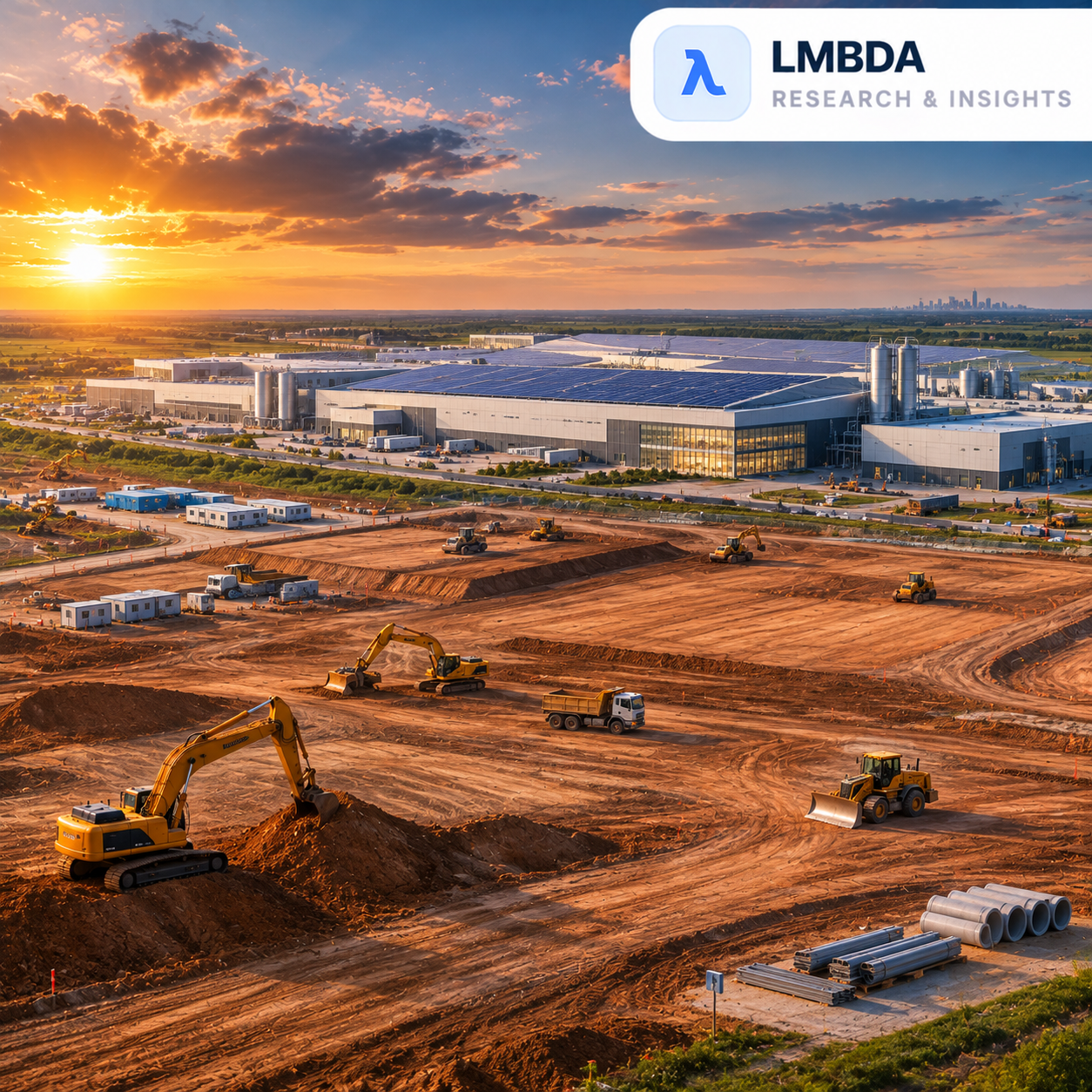
Earthmoving activity has reportedly begun at the Texas property associated with Tesla's proposed $10.1 billion solar manufacturing project, Project Crystal Sun. Drone footage highlighted by Teslarati on November 9 appears to show land clearing, machinery staging and grading in Fort Bend County, southwest of Houston. The images are an important development, but they are not equivalent to Tesla formally confirming that the full factory has broken ground or that Texas has been definitively selected.
What is independently documented is substantial. Tesla submitted an application under Texas's Jobs, Energy, Technology and Innovation (JETI) programme for a proposed photovoltaic manufacturing complex, local officials have advanced incentive agreements, and public documents set out a multiyear investment and employment plan. The distinction between verified filings, observed site activity and projected outcomes is essential to understanding the scale of this proposal.
What is Project Crystal Sun?
The proposed project is a solar-cell and solar-module manufacturing operation in Fort Bend County, within the Lamar Consolidated Independent School District. According to the district's official Tesla JETI information page, Tesla's application estimates a capital investment of approximately $10.1 billion, divided into around $1.5 billion in real property and $8.6 billion in equipment and other personal property.
Local reporting identifies a broader site of roughly 3,057 acres near FM 1994 and FM 762. That is not necessarily the area that would be occupied by manufacturing buildings. In an October 8 Fort Bend County meeting, officials discussed a smaller project footprint within the larger tract. Confusing the site-selection area with the factory footprint exaggerates the size of the planned physical plant.
The filing describes production of photovoltaic solar cells and assembled modules. Teslarati characterises the ambition as a vertically integrated supply chain reaching from silicon ingots and wafers through coated cells to finished panels. That broader manufacturing scope should be understood as the reported plan, not as proof that every upstream stage is already funded, permitted and under construction.
What the November 9 drone footage shows—and what it cannot prove
Teslarati reports that drone footage released by S.E. Robinson Jr. shows heavy equipment, large cleared areas, staging zones and earthworks on the property. Those observations are consistent with early site preparation. However, aerial footage alone cannot establish the precise legal status of the work, the identity of every contractor, the final investment decision or the issuance of all permits needed for industrial construction.
As of the material reviewed for this article, Tesla had not issued a formal groundbreaking announcement. Earlier official and local reporting also indicated that Tesla had evaluated an alternative site outside Texas. The prudent conclusion is that the reported physical activity represents a potentially meaningful step beyond paperwork, while the status of the final site commitment still requires direct company or government confirmation.
The timetable: construction through 2028, production in 2029
Tesla's application outlined construction during 2026–2028 and targeted commercial operations in the first quarter of 2029. These are forward-looking milestones, not completed events. A project involving new industrial buildings, manufacturing lines, utilities, logistics facilities and complex equipment commissioning could face schedule changes during permitting, construction and startup.
Investors and local communities should distinguish the start of earthworks from completion of the factory, installation of production equipment and commercial-scale output. Even if early civil work is underway, commissioning a fully integrated solar supply chain is a separate technical challenge.
Nearly 10,000 permanent jobs are projected—not yet created
The application projects 9,712 permanent full-time jobs by 2033 and approximately 1,147 construction jobs at peak activity. Local reporting also cites a potential annual payroll of about $1.3 billion at full operation. These numbers describe the project's proposed economic impact if it proceeds and reaches its planned scale.
For Fort Bend County, that could mean demand for skilled trades, industrial maintenance, engineering, logistics and support services. But hiring projections are not verified job creation. The practical milestones to monitor are published recruitment plans, construction contracts, equipment installation, actual employee counts and compliance reports tied to the incentive agreements.
How the tax incentives work
Lamar CISD approved a resolution advancing a school-tax value-limitation agreement under the JETI framework. Fort Bend County commissioners approved a separate package of tax and economic-development incentives in October. The district's approval and county's agreements do not, by themselves, replace remaining state-level authorisations or Tesla's final project decisions.
Texas describes JETI as an incentive programme for qualifying capital-intensive developments, including manufacturing. Its rules distinguish manufacturing facilities from renewable-energy generation projects, which are not generally eligible under the same provision. Project Crystal Sun is being proposed as manufacturing infrastructure, not merely a solar power plant.
The county package has been described as offering benefits extending potentially as long as 35 years. That upper limit is conditional: an analysis of the agreements identifies an initial ten-year abatement, followed by a rebate period, with a possible extension tied to employment thresholds. It would be misleading to describe every incentive as an unconditional 35-year tax holiday.
Why domestic solar manufacturing matters
A facility making solar cells and modules in the United States would support a strategy of building more of the photovoltaic supply chain domestically. That matters because the economics of solar energy depend not only on the cost of generating electricity but also on the availability, price and reliability of manufacturing capacity and upstream materials.
Vertical integration could give Tesla more control over product specifications, production planning and supply relationships. But it also concentrates execution risk: silicon processing, wafer production, cell fabrication and module assembly require different equipment, expertise, environmental controls and capital expenditure. A large planned investment does not guarantee internationally competitive production costs.
Public documents do not yet establish the final annual gigawatt output of Project Crystal Sun. Broader comments about Tesla's ambitions for US solar manufacturing should not be treated as a confirmed capacity rating for this particular factory.
The connection to Tesla's energy and AI ambitions
Project Crystal Sun sits at the intersection of Tesla's energy business, US industrial policy and growing interest in electricity demand from data centres and AI infrastructure. More domestic solar manufacturing could support power-generation supply chains serving households, businesses and utility-scale projects. It does not follow that every panel from this factory would be used for AI facilities or SpaceX projects; the publicly available filings do not establish a binding customer allocation.
That distinction matters as companies increasingly connect solar power, battery storage and compute infrastructure in their strategic narratives. The economic opportunity is real, but its magnitude will depend on actual manufacturing output, project costs, demand and grid development.
What still needs verification?
Four questions remain central. First, has Tesla formally selected the Fort Bend County site and authorised the complete construction programme? Second, what permits and state incentive approvals remain outstanding? Third, what annual manufacturing capacity will the plant have at startup and at full scale? Fourth, how much of the projected investment and hiring has moved from application assumptions into executed contracts?
For residents, further questions concern traffic, water and electricity requirements, industrial environmental impacts and local infrastructure. Local reporting documented both support for jobs and concerns about the development. Those issues deserve scrutiny through permitting documents and public hearings rather than assumptions drawn from promotional economic-impact estimates.
Frequently asked questions
Has Tesla officially broken ground on Project Crystal Sun?
Teslarati reported earthmoving and site preparation visible in drone footage on November 9, 2026. The material reviewed does not establish a formal Tesla groundbreaking announcement or a final confirmation that all factory construction approvals are complete.
How much will Project Crystal Sun cost?
The JETI application estimates approximately $10.1 billion in capital investment. It is a proposed amount, not proof that the entire sum has already been spent or irrevocably committed.
Where would the factory be located?
The proposed location is in Fort Bend County, Texas, near FM 1994 and FM 762, within Lamar CISD. The broader tract covers about 3,057 acres, but the actual factory footprint may be smaller.
When could production begin?
Tesla's application targets the first quarter of 2029, following a construction period projected for 2026–2028. The schedule remains subject to execution and approvals.
How many jobs could it create?
The proposal forecasts 9,712 permanent jobs by 2033 and up to 1,147 construction jobs at peak. These are projections, not jobs already verified as created.
Will the factory manufacture complete solar panels?
Official materials describe photovoltaic cell and module manufacturing. Reporting also describes an ambition for broader vertical integration, but the final production stages and capacities require confirmation as the project advances.
Why the next announcement matters more than the flyover
Project Crystal Sun is no longer just an abstract idea: it has a detailed public incentive application, local government action and now reported physical site activity. Yet a $10.1 billion factory remains a proposal until the key commitments, authorisations and construction milestones are established. The most meaningful next evidence will come from Tesla's formal disclosures, permits, contracts and measurable progress—not from the scale of the projected investment alone.
Sources
- Teslarati — Tesla begins groundworks on $10B Project Crystal Sun (November 9, 2026)
- Lamar Consolidated Independent School District — Tesla JETI application information (official)
- Texas Governor's Office — JETI programme (official)
- KPRC / Click2Houston — Fort Bend County incentive vote (October 22, 2026)
- Fort Bend County — Commissioners Court meeting, October 8, 2026 (official recording)
- Houston Chronicle — Lamar CISD incentive approval and remaining conditions