November 9, 2026 | LMBDA Research & Insights
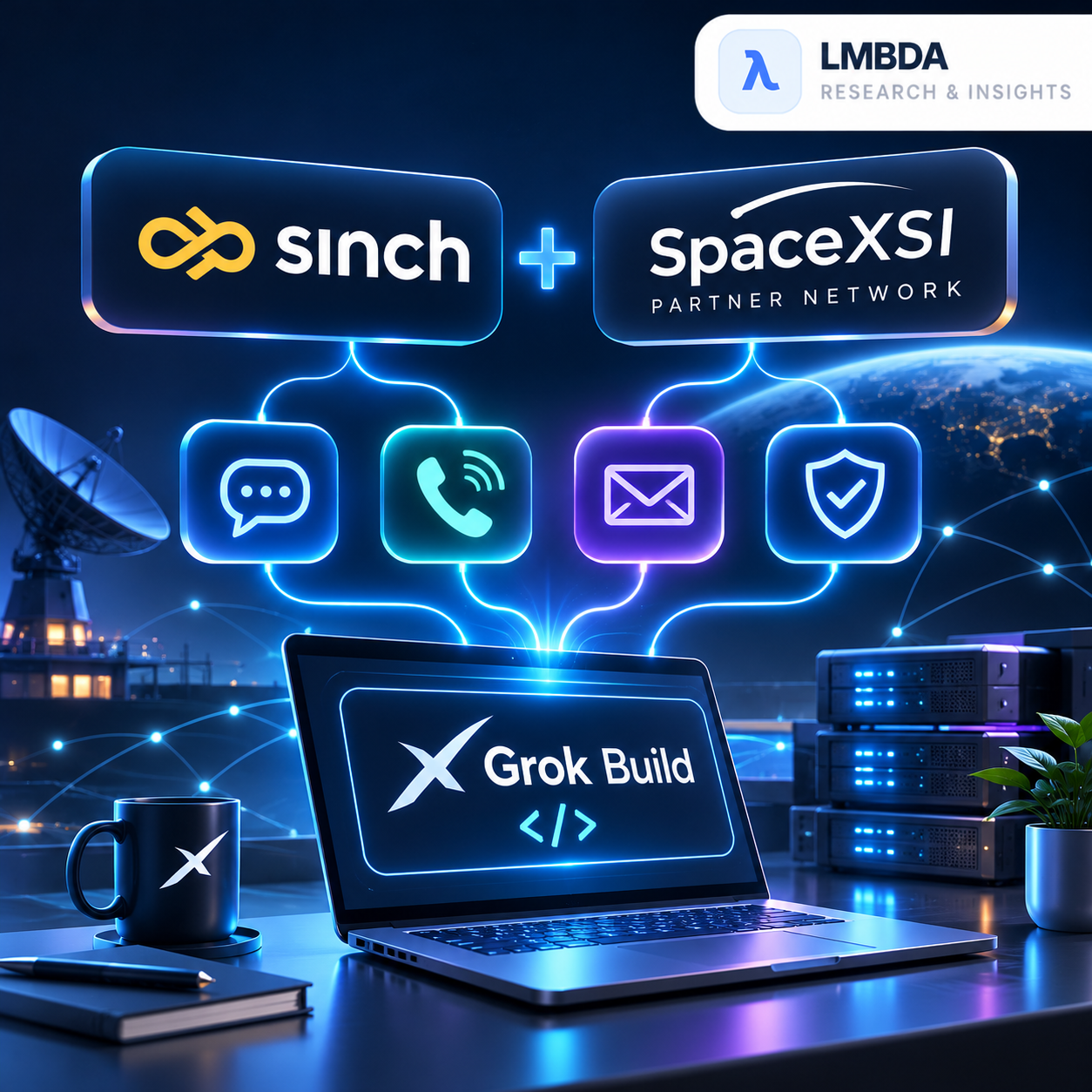
Sinch has joined the SpaceX Super Intelligence Partner Network as a Marketplace Partner, bringing customer communications infrastructure into Grok Build, the AI-assisted development environment formerly known as Cursor. Announced by Sinch on November 4 and reported by IT Brief Australia on November 9, the partnership covers voice, messaging, email and verification capabilities that developers and coding agents can incorporate while building applications.
The announcement is more consequential than a conventional software integration. It illustrates how AI coding environments are becoming distribution channels for the services an application needs to operate in the real world. Instead of generating a prototype and then separately researching APIs for sending messages, authenticating users or contacting customers, a developer can bring those capabilities into the same workflow.
What Sinch and SpaceXSI actually announced
According to Sinch's official November 4 press release, the company was named a Marketplace Partner in the SpaceX Super Intelligence (SpaceXSI) Partner Network. The integration is intended for enterprise applications built using Grok Build, the development product described in the announcement as formerly Cursor.
Sinch's offering combines its Model Context Protocol (MCP) server with 15 skills in a single plugin, available through the Cursor Marketplace. The package gives developers and AI coding agents access to Sinch API knowledge and tools for implementing communications features. The announcement says teams can use it to develop and test messaging and verification workflows without separately navigating documentation or building every integration from scratch.
The announcement confirms partner status and plugin availability. It does not disclose financial terms, customer adoption figures attributable to this integration or independent measurements of development time saved.
Why the partner network matters
The SpaceXSI Partner Network, introduced on October 22, divides participants into two broad groups. Transformation Partners help organisations deploy Grok across business operations, while Marketplace Partners develop plugins and integrations that connect Grok products with external tools and services.
SpaceXSI said more than 130 companies participated in the programme's early-access phase. That number refers to participation in the network's early-access programme, not to Sinch customers or deployments of the Sinch plugin.
The distinction between partner categories matters. Sinch is not primarily announcing a consultancy programme or a new general-purpose AI model. It is positioning its communications services as infrastructure that AI-assisted developers can select and integrate at the point of application creation.
From code generation to production communications
AI coding tools can produce application logic and user interfaces quickly, but a working business application often needs services outside the codebase. It may need to verify a phone number, send a one-time password, deliver a transaction notification, contact a customer by email or route a voice interaction.
These functions have operational requirements: API credentials, delivery status, retries, error handling, user consent, rate limits, data protection and sometimes country-specific messaging rules. A generated code snippet is not enough to make them reliable.
Sinch's proposition is to place communications APIs and implementation guidance closer to the developer and coding agent. That can shorten the distance between an application prototype and a system capable of interacting with real customers. But the plugin does not eliminate the need to configure accounts, protect credentials, test edge cases or comply with applicable rules.
What MCP and the 15 skills contribute
Model Context Protocol provides a standardised way for AI applications and development environments to interact with external tools and services. In this case, Sinch says its MCP server and skills expose API knowledge and communications-building workflows to developers and coding agents.
That may allow an agent to locate the relevant Sinch capability, understand how it is called and help implement or test it without relying entirely on a developer's manual search through documentation. The skills provide task-oriented guidance within the plugin package.
However, the public announcement does not enumerate all 15 skills or demonstrate that every Sinch product is fully automated end to end. The appropriate interpretation is that Sinch has made a packaged integration available, not that the integration independently handles all production deployment and compliance responsibilities.
Four practical enterprise use cases
Customer service and support
An AI-assisted support application could classify an incoming request, generate a response and use a messaging or email API to communicate with the customer. A production implementation would still need authentication, human escalation rules, delivery monitoring and safeguards against sending incorrect or sensitive information.
Account verification and onboarding
A business could add phone-based verification to an onboarding workflow while building the application. Developers would need to manage consent, verification expiry, retry limits, abuse prevention and regional requirements. The plugin may accelerate integration, but does not replace security design.
Transactional notifications
An order-management application could send confirmations, status updates or service alerts. The system should distinguish transactional communications from marketing messages, enforce the relevant consent rules and handle failures and duplicate sends.
Agent-assisted operations
An internal AI agent could trigger a notification when a workflow reaches a particular state, such as a support case requiring approval. For higher-risk actions, the organisation should define which messages may be sent automatically and which require human confirmation.
Why this matters for the emerging agent ecosystem
For AI platform operators, marketplaces make their development environments more useful by offering access to third-party infrastructure. For suppliers such as Sinch, the same marketplaces provide a way to be discovered earlier in the software lifecycle.
This changes the competitive position of infrastructure vendors. Historically, a team might choose a messaging provider after deciding what application to build. In an AI-assisted workflow, the provider may become visible while the developer or agent is planning the application, suggesting integrations or selecting tools.
That is a form of tool discovery, not conventional web search. It can influence which services developers consider, but it does not prove that a brand will be cited more often in Grok answers or gain additional organic search traffic.
Implications for digital discovery and AI visibility
The partnership is relevant to LMBDA's research on how agents select tools and services. In a conventional search journey, a developer may search for a messaging API, compare providers and read documentation. In an agent-assisted environment, discovery may happen through marketplace listings, available tool schemas, plugin descriptions, documentation and the agent's ability to use those resources.
For API and SaaS providers, this suggests several areas worth measuring: whether a service is listed in the relevant marketplaces, whether its tools are clearly described, whether documentation matches current API behaviour, and whether agents can successfully complete realistic integration tasks.
It would be premature to claim that MCP compatibility or a marketplace listing is a direct ranking factor in AI search. There is no evidence in this announcement that the Sinch integration changes Grok's public search ranking, citation selection or recommendation policies. Its demonstrated relevance is to developer workflows and the availability of tools within an AI product ecosystem.
What businesses should check before adopting it
- Plugin availability: confirm the Sinch package is present in the relevant marketplace and compatible with the development environment in use.
- Credentials and permissions: determine how API keys and account access are stored, scoped and revoked.
- Supported functions: verify which messaging, voice, email and verification operations are available in the plugin rather than assuming every product is included.
- Compliance: check consent, retention, regional messaging rules and applicable privacy obligations.
- Testing: validate delivery status, errors, retries, duplicate actions, abuse limits and human approval paths before production use.
- Commercial terms: confirm Sinch service pricing and usage charges separately; the partnership announcement does not establish that communications are free.
- Observability: log agent tool calls and outcomes so teams can distinguish successful API execution from a generated response that merely claims success.
What remains unknown
The announcements do not provide a customer deployment count for the Sinch integration, a benchmark showing faster development, the full list of 15 skills or a detailed commercial agreement between the companies. They also do not establish that Grok Build automatically deploys compliant production communications workflows without engineering oversight.
Those gaps matter because partner announcements often describe intended capabilities rather than measured business outcomes. The strongest verifiable conclusion is that Sinch has entered the SpaceXSI marketplace ecosystem and released a packaged MCP-and-skills integration for developers.
Frequently asked questions
What is Sinch's role in the SpaceXSI Partner Network?
Sinch is a Marketplace Partner providing communications infrastructure and a developer plugin for applications built in Grok Build. It is not described as a new AI model provider in the announcement.
When was the partnership announced?
Sinch issued its official announcement on November 4, 2026. IT Brief Australia reported the development on November 9.
What is Grok Build?
Grok Build is the AI-assisted development environment referred to in the official announcement as formerly Cursor. The integration is designed to bring external communications capabilities into its application-building workflows.
What does the Sinch plugin include?
Sinch says it bundles an MCP server and 15 skills in one installation, offering access to API knowledge and tools for communications integration and testing.
Which communications functions are involved?
The partnership covers voice, verification, messaging and email infrastructure. The precise functions available in a particular implementation should be checked against the current plugin and Sinch API documentation.
Is the plugin available now?
Sinch's November 4 release says the plugin is available through the Cursor Marketplace. Availability in a particular environment should be checked directly before deployment.
Does the integration automatically make AI agents compliant?
No. Sinch describes its infrastructure as compliance-ready, but organisations remain responsible for implementation, permissions, consent, data handling and applicable legal obligations.
Does this change SEO or AI search rankings?
No ranking change is established. The more relevant implication is that AI agents may discover and select services through marketplaces, tools and structured integrations rather than through a conventional search-results page.
Conclusion: AI development is becoming an infrastructure marketplace
Sinch's entry into the SpaceXSI Partner Network illustrates an important change in AI software development. Coding agents are moving beyond generating application code toward selecting and integrating the services needed to operate that software. Communications infrastructure is a natural part of that shift because business applications need to reach, verify and support real people.
For Sinch, the opportunity is to become part of the developer's workflow earlier. For SpaceXSI, the partnership expands the ecosystem of tools available around Grok Build. For enterprises, the practical benefit will depend on whether these integrations can be configured, tested, governed and operated reliably.
The wider signal is clear: as agents become software builders, the marketplace in which they find and use infrastructure may become as important as the interface in which they write code.