LMBDA Research & Insights | November 10, 2026
Autonomous trucking companies have spent years trying to teach conventional tractor-trailers to drive themselves. Humble Robotics is pursuing a more radical question: what if the tractor, its cab and the separate trailer chassis were never necessary in the first place?
On November 5, 2026, the San Francisco startup announced a $51 million Series A funding round led by Obvious Ventures, bringing total disclosed funding to $75 million. The investment will support customer pilots, validation and early manufacturing of the Humble Hauler, a battery-electric, cabless freight vehicle designed to move containers and other loads between ports, rail terminals, factories and warehouses. Electrek revisited the concept on November 9, highlighting the company's transition from a rapid prototype to a preproduction programme.
The funding is confirmed. Commercial deployment at scale is not. Humble's technology remains in development, and the company's proposed operating economics still need to be demonstrated with paying customers.
What is the Humble Hauler?
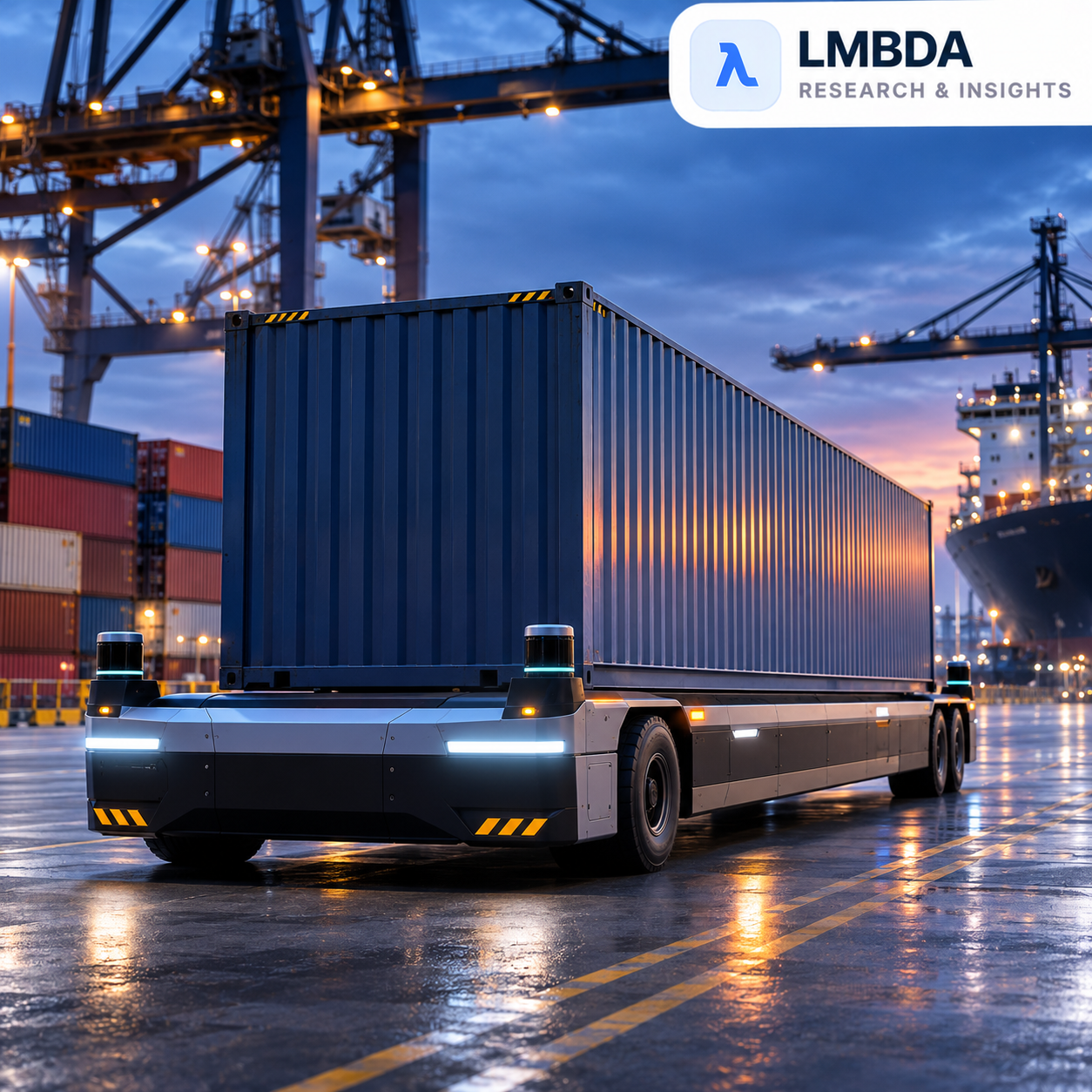
The Humble Hauler is a self-propelled electric freight platform that combines the functions of a tractor and container chassis. Instead of attaching a trailer to a separate truck, the container rides on a vehicle whose propulsion, steering, sensing and autonomous-driving hardware are integrated into the load-carrying structure.
The design has no driver's cab, steering wheel or conventional tractor-trailer coupling. Its intended advantage is a lower, lighter platform that can approach loading docks without the blind spots and manoeuvring limitations of a traditional tractor pulling a long trailer. The company initially designed the vehicle around standard shipping containers and plans additional configurations for regional freight.
Humble describes its target as dock-to-dock transport: moving goods between facilities, including the difficult last metres of positioning at a loading bay. This is an operational ambition rather than evidence that the system has already achieved broad driverless commercial service.
The $51 million Series A: who invested and what comes next?
According to Humble's November 5 announcement, Obvious Ventures led the Series A, with existing investors Eclipse and Energy Impact Partners participating. The new $51 million round follows a $24 million seed financing announced when Humble emerged from stealth in April, taking total disclosed funding to $75 million.
The company says the proceeds will support four workstreams: customer pilots, testing and validation, early manufacturing, and development of additional vehicle variants. The funding announcement did not identify signed commercial customers, disclose binding fleet orders or demonstrate profitability.
That distinction is important for evaluating a young physical-AI company. Raising capital shows that investors are prepared to finance further development; it does not validate the claimed per-mile savings, safety performance or future market share.
Why Humble is starting with short regional routes
Humble's initial focus is on repeatable regional freight moves rather than coast-to-coast trucking. It cites federal freight data indicating that 87% of US truck tonnage moves less than 250 miles. The company sees an opportunity in port drayage, plant-to-warehouse shuttles, rail-yard movements and terminal-to-terminal trips.
These routes offer potential advantages for battery-electric autonomy. Vehicles can operate within known geographic areas, return to familiar charging facilities and receive support from nearby depots. Shorter routes can also reduce the battery capacity needed compared with a long-haul truck, although actual energy requirements depend on payload, speed, grades, climate and dwell times.
It is essential not to confuse the company's target market of routes under 250 miles with the current vehicle's advertised maximum range. Humble's website lists a maximum range of approximately 200 miles and a top speed of 55 mph. Those are company specifications, not independent fleet-test results, and they do not mean every under-250-mile route can be completed without charging.
Vision-language-action models meet cameras, lidar and radar
The Hauler is an example of physical AI: machine-learning systems intended to interpret an environment and choose actions in the physical world. Humble says its autonomy stack uses vision-language-action models, supported by cameras, lidar and radar providing a 360-degree view around the platform.
A vision-language-action model attempts to connect visual observations and other context with possible driving actions. In principle, that can help a system handle complex industrial situations that are difficult to cover with manually enumerated rules alone. But a model's ability to produce plausible actions is not equivalent to verified safety in an operating port.
Real environments include forklifts, workers on foot, temporary obstacles, moving containers, poorly marked lanes and changing weather. Humble must show that its perception, planning, braking, redundancy and remote-support systems handle these situations reliably. The company says it uses simulation to test routes extensively, but simulation should complement, not replace, appropriately supervised real-world validation.
Why removing the cab could change freight economics
A traditional freight operation separates the relatively expensive tractor from a trailer that may spend hours being loaded, unloaded or waiting at a terminal. Humble removes the cab and combines tractor and chassis into a single electric machine. Its website claims the resulting platform is about 20% lighter than a conventional tractor-and-trailer combination.
Lower vehicle weight could create room for additional payload or reduce energy use, subject to axle limits, container weights and road regulations. Eliminating a cab also removes components that serve a human driver, while an electric powertrain avoids diesel fuel consumption at the vehicle.
However, the integrated architecture creates an economic trade-off. In a conventional fleet, the tractor can leave one trailer at a dock and collect another while loading continues. If a self-propelled platform must remain beneath its load during long dwell times, expensive batteries, sensors and autonomy hardware may sit idle. Humble's actual loading interface, drop-and-hook equivalent and fleet scheduling will therefore be central to whether its cost-per-mile proposition holds up.
The appropriate comparison is total cost per delivered container or tonne, not just the weight of the vehicle. Operators should include vehicle acquisition or leasing, charging infrastructure, electricity, maintenance, insurance, remote operations, downtime, loading delays, utilisation and regulatory compliance.
What has actually been built and tested?
Humble announced its first prototype in April 2026, saying it had developed the vehicle in under six months. Industry reporting in November describes the new funding as a step toward customer pilots and preproduction. The company has not publicly demonstrated an established fleet carrying commercial loads at scale.
FreightWaves reports that Humble plans customer pilots and is working with regulators and logistics partners. Business Insider reports an intended progression from route-data gathering to pilots and potential commercial operations in 2027, subject to approvals. These are planned milestones, not achieved deployment dates.
For a Class 8 vehicle intended to operate on public roads, regulatory permission, insurance, vehicle compliance and documented safety procedures are as important as model performance. Requirements vary by state and by the precise operational design domain.
The electric and autonomous competition
Humble's bet differs from companies that retrofit autonomous-driving systems to existing trucks. Its founders believe the full vehicle can be optimised around autonomy rather than preserving hardware built for a human driver. That could improve visibility and manoeuvrability in industrial settings, but it also requires Humble to design, manufacture and support an entirely new vehicle platform.
Other autonomous-freight developers have made progress with conventional truck architectures, while electric truck makers face their own charging and cost challenges. Humble is attempting both transitions at once: new vehicle hardware and new driving intelligence. This makes the potential upside significant but raises capital intensity and execution risk.
Five questions freight operators should ask before joining a pilot
1. What route is approved? Define the precise start and end points, road types, speed limits, weather conditions, operating hours and regulator permissions.
2. What is the real payload and range? Request measured energy use with representative cargo, charging times, axle-load compliance and performance under adverse weather.
3. How does loading work? Determine whether the autonomous platform remains occupied during loading, how containers are secured and how much dwell time the equipment incurs.
4. Who intervenes when autonomy cannot proceed? Clarify remote assistance, emergency response, recovery procedures, staffing, liability and the system's safe-stop behaviour.
5. How will economics be measured? Compare cost per completed move and equipment utilisation against an existing tractor-and-chassis operation over a meaningful trial period, rather than relying on headline weight savings.
Frequently asked questions
Is the Humble Hauler a trailer or a truck?
It combines elements of both. The Hauler is a self-propelled battery-electric cargo platform designed to carry freight without a separate tractor or driver's cab.
How much funding has Humble Robotics raised?
Humble announced a $51 million Series A in November 2026, following a $24 million seed round, for $75 million in disclosed funding.
Who led the new investment?
Obvious Ventures led the Series A, with Eclipse, Energy Impact Partners and others participating.
What is the Humble Hauler's range?
Humble advertises a maximum range of 200 miles and a top speed of 55 mph. Real-world performance will depend on payload and operating conditions.
Does it use generative AI?
Humble describes vision-language-action models in its autonomous-driving system. The company has not published sufficient independent validation to conclude that those models can safely handle every unfamiliar freight scenario.
Can customers use it commercially today?
As of November 2026, the company is preparing customer pilots and early manufacturing. Broad commercial availability has not been established.
Will it replace all tractor-trailers?
That is not the stated near-term goal. Humble is concentrating on specific short, repeatable freight routes where an integrated cabless design may offer advantages.
What the next twelve months must prove
Humble Robotics has secured meaningful backing for a different approach to freight autonomy: design the machine around the cargo and the route, rather than automate a truck built for a human driver. The concept is technically interesting because it links vehicle architecture, electrification and physical AI.
The next decisive evidence will come from operational pilots: completed freight moves, safety records, uptime, loading efficiency, measured range and transparent cost comparisons. Until then, the $75 million funding total is a milestone for development—not proof that the truckless truck has already transformed logistics.
Sources
- Humble Robotics — November 5, 2026 Series A announcement (company primary source)
- Humble Robotics — Official vehicle specifications and intended use cases
- Humble Robotics — April 21, 2026 launch announcement
- Electrek — Humble Hauler funding update, November 9, 2026
- FreightWaves — Funding, pilot plans and freight operations analysis
- Transport Topics — Vehicle technology and validation plans