LMBDA Research & Insights | Mobility | November 10, 2026
Honda has brought one of its most unconventional motorcycle concepts to a European audience. The EV OUTLIER Concept, first unveiled at the Japan Mobility Show in October 2025, appeared at EICMA 2026 in Milan as a vision of what electric motorcycles might become after 2030. The machine is not a confirmed production model. Its significance is that Honda is asking a deeper design question: what happens when a motorcycle no longer needs to be organized around an internal-combustion engine, fuel tank and conventional drivetrain?
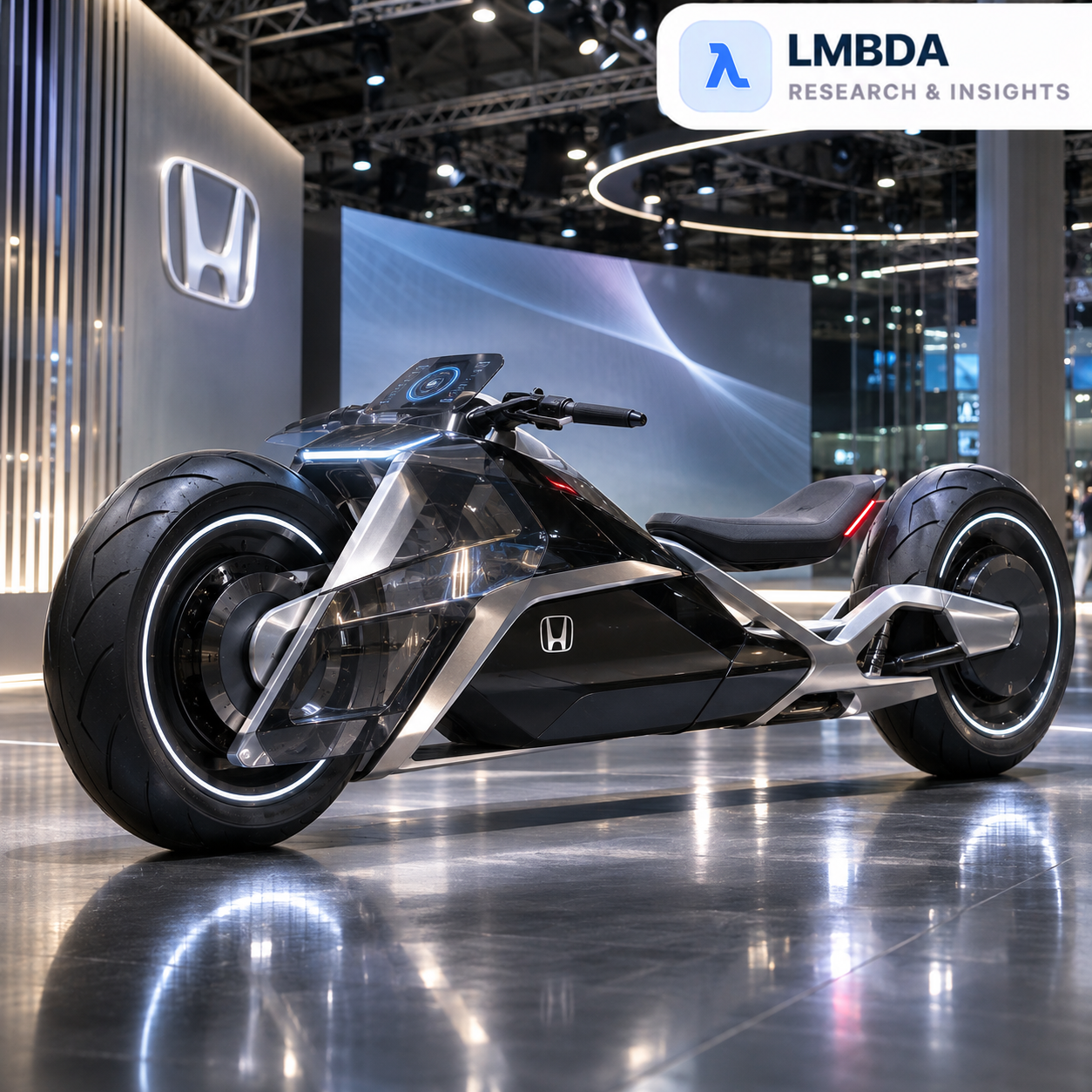
The answer is a low, elongated vehicle with an electric motor integrated into each wheel, a deeply recessed riding position and a digital cockpit designed to communicate how the machine is behaving. It looks strikingly different from familiar road motorcycles, but many of its unusual features follow from the same engineering principle: electric propulsion gives designers more freedom to position components.
What was actually announced at EICMA 2026?
Honda's November 3, 2026 EICMA announcement confirms that the EV OUTLIER Concept was presented in Europe for the first time. The company describes it as a proposal for a new direction in motorcycles from 2030 onward, not an announced retail product.
The distinction matters because some headlines may give the impression that Honda has just introduced its next electric motorcycle for sale. In reality, the concept had its world premiere at the Japan Mobility Show in October 2025. Its appearance in Milan is a new public showing of an existing design exploration, not confirmation of a launch date, order book or production specifications.
Electrek's November 10 report, written after seeing the vehicle in person at EICMA, highlights precisely how far Honda has moved from the proportions of a conventional motorcycle.
Two in-wheel motors change the motorcycle's architecture
The EV OUTLIER Concept places motors inside both the front and rear wheels. Honda says this layout takes advantage of the packaging freedom available with electric propulsion and allows the drive force at each wheel to be controlled according to conditions. Unlike the familiar arrangement of a central engine or motor delivering power through a chain, belt or shaft, the concept locates propulsion at the wheels themselves.
This configuration opens possibilities for traction management and vehicle layout, but it also introduces questions that a production program would have to answer. Motor mass within the wheels can affect unsprung weight and suspension response; packaging, cooling, durability and serviceability would also need validation. Honda's concept materials explain the intended riding experience, not a final engineering trade-off analysis for a commercially available motorcycle.
The central black body contains the battery, according to Honda's design interview. Separating the battery visually from other components helps create the concept's unusual proportions.
Honda's three design principles: Gliding, Ecstasy and Low
Honda organizes the concept around three ideas that it calls Gliding, Ecstasy and Low. The names are expressive, but each points to a specific design ambition.
Gliding describes the smooth and quiet delivery of electric propulsion, including gentle transitions between acceleration, deceleration and cornering. Honda wants the motorcycle to feel as though it is moving effortlessly across the road.
Ecstasy refers to the immediate response and high torque possible with electric motors. By controlling the front and rear wheel motors independently, Honda imagines a more direct and emotionally engaging connection between rider inputs and movement. This is a design goal, not an independently verified performance result.
Low is literal. The concept pushes the rider's seat and eye position unusually close to the road. A bucket-like backrest supports the rider under acceleration and is intended to create a different way of moving through corners, with the hips functioning as a pivot point. Honda deliberately gives the front of the machine visual mass to accentuate the low seating position.
A cockpit built around cameras and riding data
The concept replaces traditional protruding mirrors with camera-based rear views integrated into the cockpit design. Honda describes a wide, slim instrument arrangement intended to preserve forward visibility while displaying riding information.
Its interface concept includes lean-angle information, riding modes, front-motor torque adjustment and indications of front and rear wheel behavior. Honda also discusses the possibility of linking rider preferences and personal information to more tailored vehicle control and destination suggestions.
These functions should be read as elements of a concept interface. They do not establish that every proposed display, personalization function or camera system has been validated for road-legal production in any specific market.
What Honda has not confirmed
As of November 10, 2026, Honda's published materials do not provide a retail price, ordering date, production start, confirmed market availability, certified range, battery capacity, charging time, peak power or top speed for a production EV OUTLIER. They also do not establish that the show vehicle will be manufactured unchanged.
Honda explicitly frames the project as a vision for motorcycles beyond 2030. That is a design horizon, not a promised launch in 2030. Any numerical performance claim circulating without a Honda specification sheet should be treated cautiously.
Why this is different from simply electrifying an existing motorcycle
Many electric motorcycles preserve recognizable motorcycle geometry: a familiar saddle height, a central power unit and a frame arranged much like a gasoline-powered bike. That can be practical because it draws on established riding dynamics, manufacturing processes and customer expectations.
The EV OUTLIER asks what might happen if those conventions were reconsidered. Without a bulky combustion engine, designers can move the battery, lower the rider and explore new weight distribution and drive layouts. This is not automatically a better solution for daily transport. The concept is valuable because it makes the design possibilities visible and invites further engineering evaluation.
Honda's interview with project leader Yuya Tsutsumi describes an unusually open development process involving motorcycle designers, power-products specialists and international colleagues. The team deliberately challenged assumptions about what motorcycle proportions should look like.
How the concept fits Honda's wider electric strategy
The EV OUTLIER should not be confused with Honda's more immediate electric motorcycle products. Honda's concept materials place it alongside the EV FUN and EV Urban design explorations shown at EICMA 2024. Those projects explore different points on the spectrum between practical electrification and future-facing design.
The wider EICMA 2026 program also demonstrates that Honda is pursuing multiple propulsion technologies at once, from conventional motorcycles to electrified and electric-assist mobility. The EV OUTLIER is the company's more experimental statement about what an electric motorcycle could eventually become.
Honda's design work also earned a 2026 Red Dot Design Award in the design concept category. An award recognizes the concept's design achievement; it does not certify production readiness or real-world performance.
The engineering questions that matter before production
For a roadgoing version, engineers would need to establish the balance between wheel-motor benefits and unsprung mass, validate cooling and durability, demonstrate safe behavior under braking and traction changes, and meet applicable lighting, mirror or camera, braking and other homologation requirements.
They would also need to establish battery capacity, realistic range under different riding conditions, charging compatibility, repair costs and the ergonomics of such an unusually low position. A dramatic exhibition prototype does not answer those ownership questions.
That is why a concept should be evaluated for the ideas it tests rather than judged as if it were already a finished consumer product.
Frequently asked questions
Is the Honda EV OUTLIER Concept available to buy?
No. Honda presents it as a concept for future motorcycles and has not announced retail availability or pricing.
When was the EV OUTLIER first revealed?
It made its world premiere at the Japan Mobility Show in October 2025 and its European debut at EICMA 2026 in Milan.
Does the concept have all-wheel drive?
It has motors integrated into both the front and rear wheels, with Honda describing control of driving force at each wheel. That is a two-wheel-drive concept layout, not a published production specification.
What do Gliding, Ecstasy and Low mean?
They are Honda's design principles for smooth electric movement, responsive high-torque propulsion and an exceptionally low riding position.
What is its range and battery size?
Honda has not provided confirmed production range or battery specifications for the concept.
Will Honda launch it in 2030?
Honda says the concept envisions motorcycles beyond 2030. It has not committed to a launch year.
Are the cameras and screens production-ready?
Honda describes them as elements of the concept's human-machine interface. Road-legal implementation and market-specific certification remain unconfirmed.
The bigger story: electric motorcycles may stop looking conventional
Honda's EV OUTLIER is not evidence that an exotic new motorcycle is about to reach showrooms. It is evidence that a major manufacturer is actively exploring how electric propulsion could change the fundamentals of motorcycle design. In-wheel motors, an unusually low seating position and a cockpit built around digital feedback all point to a future in which electrification influences the riding experience, not merely the fuel source.
Whether the exact vehicle reaches production is an open question. The more important development is Honda's willingness to challenge long-established assumptions about how a motorcycle should be packaged and ridden.
Sources
- Honda — Overview of Honda Exhibits at EICMA 2026 (November 3, 2026)
- Honda — CEO Speech at Japan Mobility Show 2025 (October 29, 2025)
- Honda Design — EV OUTLIER Concept project
- Honda Design — Interview on the EV OUTLIER Concept
- Honda Design — 2026 Red Dot Award information
- Electrek — Honda shows off its next electric motorcycle (November 10, 2026)
Editorial image note: the separate LMBDA cover is an artistic interpretation of future electric-motorcycle design, not an official Honda product photograph or an exact depiction of the EV OUTLIER Concept.