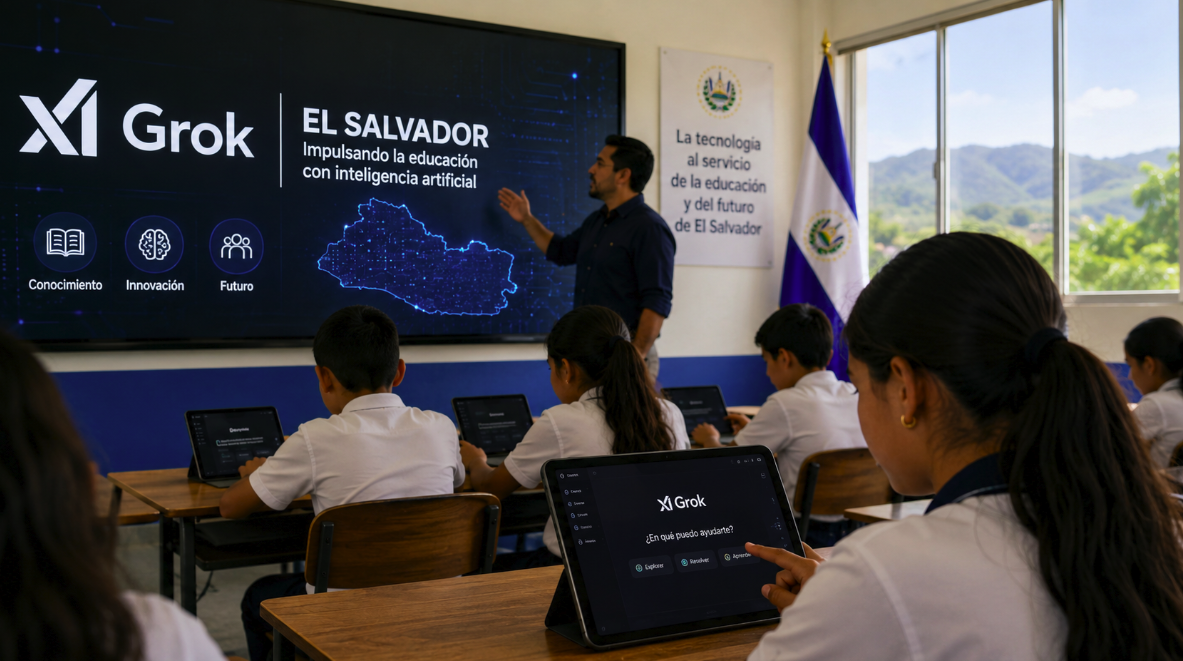
El Salvador is attempting to move generative AI from an optional classroom tool into the operating infrastructure of public education. Under a partnership announced with Elon Musk’s xAI, the country plans to use Grok to provide personalized tutoring across more than 5,000 public schools, potentially reaching more than one million students. At that scale, the experiment is no longer mainly about whether a chatbot can explain algebra or summarize a text. It is about whether a commercial frontier model can become a dependable component of a national education system.
The scope and implementation questions were recently examined in a NetContentSEO analysis of El Salvador’s Grok education program. The central distinction is important: the partnership is real and unusually ambitious, but an announced nationwide rollout is not the same thing as demonstrated nationwide educational effectiveness.
The official xAI announcement and the Salvadoran presidency say the two sides agreed in December 2025 to develop and deploy the system over two years. The planned platform is supposed to align with El Salvador’s curriculum, adapt instruction to each student’s pace and mastery, and involve thousands of teachers rather than positioning AI simply as their replacement.
National scale changes the risk calculation
AI tutoring is attractive because software can theoretically provide individualized explanations and practice at a scale that human staffing cannot easily match. A teacher managing a large classroom has limited time to diagnose every misconception or repeatedly reformulate the same concept for individual students. An adaptive tutor can potentially perform some of that work continuously, giving students additional support while allowing teachers to focus attention where human judgment matters most.
At national scale, however, the same multiplier applies to failures. An unreliable explanation presented to a few students is a classroom problem. A systematic error embedded in software used across thousands of schools can become a national curriculum problem. Bias, inappropriate responses, poor Spanish-language localization or weak pedagogical design can propagate just as efficiently as useful tutoring.
This makes the quality threshold fundamentally different from that of a consumer chatbot. A public-school AI system must work for children with different ages, reading abilities, socioeconomic circumstances and levels of connectivity. It must also function inside established curricular objectives instead of simply producing plausible answers to arbitrary questions.
The deployment numbers need careful interpretation
Official descriptions consistently establish the intended scale: more than 5,000 schools and more than one million students. xAI describes the initiative as a two-year deployment, while El Salvador has promoted it as the first nationwide AI-powered education program of its kind. More recent reporting and institutional material also show that the country is continuing a broader modernization of public schools and digital infrastructure.
There is nevertheless a difference between infrastructure being “implemented” across a school system and every intended student actively using a mature AI tutor in daily lessons. The most useful next set of data will therefore be operational rather than promotional: how many schools have active access, which grades and subjects are covered, how often students use the system, what training teachers receive, and which technical requirements determine whether a school can participate effectively.
That distinction matters because El Salvador could become a reference case for other governments. Policymakers evaluating the experiment need more than a deployment headline. They need to know what it costs per student, how the platform performs in rural schools, how connectivity failures are handled and whether teachers incorporate it into normal instruction rather than treating it as a separate technology demonstration.
El Salvador is modernizing more than its AI software
The Grok partnership sits inside a much larger education modernization program. Recent Salvadoran reporting has described investment in school buildings, devices, digital skills and technology access, while the Ministry of Education continues to procure new educational technology. On August 21, for example, the ministry published a competitive procurement for an integrated system to capture, process and manage educational video in schools.
That wider context is important because an AI tutor cannot compensate for missing physical infrastructure indefinitely. Reliable devices, networks, electricity, classroom management and teacher training remain prerequisites. The promise of generative AI is that it can reduce the marginal cost of individualized academic support; it does not eliminate the material conditions required to deliver education.
The country’s AI ambitions also extend beyond schools. UNESCO reported in June on El Salvador’s broader efforts to develop human-centered AI governance and a national AI strategy, highlighting deployments in public services as well as the Grok education initiative. That makes the school program part of a larger state strategy to use AI as an accelerator for institutional modernization.
Vendor dependence becomes a public-policy question
Putting a proprietary model near the center of public education creates a form of dependency that differs from buying textbooks or laptops. A printed textbook remains substantially the same after a school purchases it. A cloud-hosted AI system can change centrally as models, safety policies, interfaces and underlying infrastructure are updated.
That means model governance must continue after procurement. Schools and education authorities need ways to evaluate changes, report problematic answers, audit performance and decide whether an update remains appropriate for students. They also need an exit strategy. If pricing, technical architecture, corporate priorities or model behavior changes, a national school system should not discover that its educational workflows are inseparable from one vendor.
The xAI announcement says the partnership intends to create methodologies, datasets and frameworks for responsible classroom AI, with attention to local context and safety. The practical details of those mechanisms will matter enormously. Other governments will want to know who controls educational data, who can audit the system and how much authority the Salvadoran state retains over the behavior of a model developed by a private company.
Children’s data raises the standard further
Personalization works best when software remembers what a student understands, where they struggle and which explanations help them improve. That learning history can be educationally useful, but it is also sensitive data about a child. A system deployed through compulsory public education therefore requires unusually clear rules governing collection, retention, access, security and secondary use.
The question becomes especially consequential if interactions are used to improve future educational models. A deployment covering a large share of a country’s schoolchildren could produce an extraordinarily valuable dataset about how students learn with AI: which explanations work, where models fail, when hints become dependency and when a human teacher needs to intervene.
Such research could benefit education globally, but public benefit cannot be assumed automatically. Governance should establish whether student interactions can be used for model development, how data is anonymized, what rights parents and students have, and what the Salvadoran education system receives if its classrooms help produce commercially valuable educational technology.
The decisive metric is learning, not adoption
The easiest numbers to publish will be accounts created, devices connected, prompts submitted and schools technically enabled. None of those proves that students are learning more. The strongest evaluation would measure academic outcomes against credible baselines and comparison groups while also tracking teacher workload, attendance, engagement and differences between urban and rural students.
If the system works, the impact could be substantial. Individual tutoring has historically been expensive because expert human attention does not scale cheaply. A reliable AI tutor could change that equation, particularly in places where specialist teaching resources are unevenly distributed. El Salvador would then have evidence for a genuinely important form of technological leapfrogging rather than simply a high-profile AI deployment.
If outcomes fail to improve, that result would be equally valuable. It could show that model capability is less important than pedagogy, teacher integration or classroom infrastructure, or that current generative systems remain too unreliable for intensive educational use. Either result would give other countries evidence they currently lack.
That is why El Salvador’s project deserves attention beyond the politics surrounding xAI, Grok or President Nayib Bukele. The experiment is testing what happens when frontier AI stops being an application that students may choose to open and starts becoming part of the machinery through which a state delivers education. The announcement established the ambition. The next phase must establish whether the technology can earn the reliability, accountability and measurable effectiveness expected of public infrastructure.