LMBDA Research & Insights | November 9, 2026
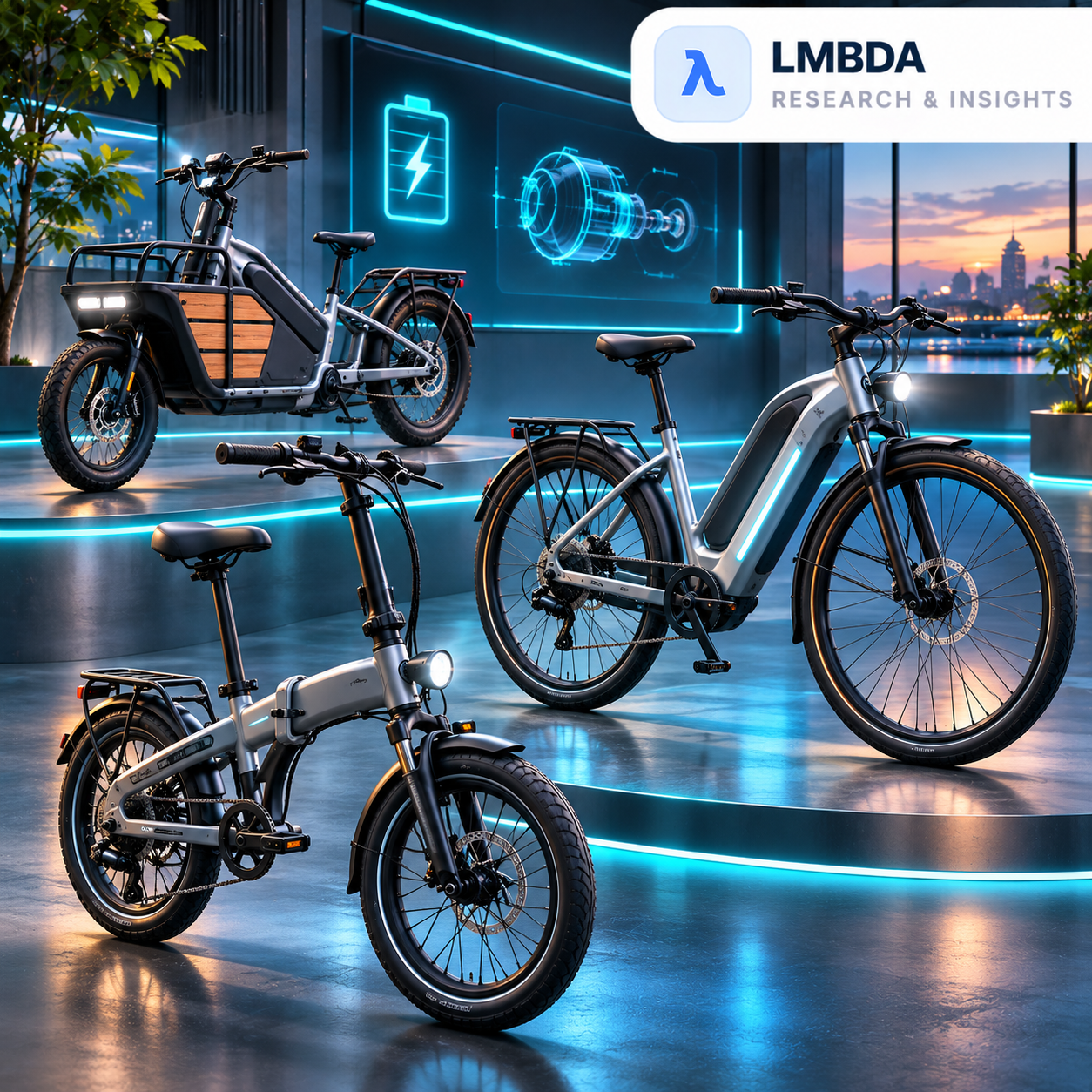
Electric bicycles have moved far beyond the choice between a cheap commuter and an expensive enthusiast machine. A November 2026 buying guide from Electrek, written by long-time e-bike reviewer Micah Toll, spans folding city bikes, mid-drive commuters, cargo machines, lightweight carbon-fibre designs and powerful moped-style models. The prices run from below $800 to several thousand dollars. The bigger story is what buyers now receive at each price point—and how difficult it can be to compare seemingly similar machines.
Electrek's list is based on the author's reported hands-on experience. It is an editorial selection, not a representative market survey, independent laboratory ranking or proof that each featured model is available worldwide. LMBDA examined the specifications and examples in the guide to identify the engineering and purchasing trends behind the recommendations.
Under $1,000: hydraulic brakes and usable batteries enter the budget segment
Electrek highlights the Lectric XP LITE 3.0 at a reported $799. The folding model uses a 48-volt system with a 375 Wh base battery, hydraulic disc brakes, integrated lights and a claimed maximum assisted or throttle speed of 20 mph in its US configuration. The reviewer describes it as an unusually well-equipped entry-level option, although accessories and a larger battery cost extra.
The Lectric XP4, starting at a reported $999, offers a different compromise: more motor power, a larger frame and a choice of batteries, with the higher-spec US configuration capable of pedal assistance up to 28 mph. Ride1Up's Portola 02 competes in the same folding-bike segment with a torque sensor, hydraulic brakes and battery options.
These examples show that a low price no longer necessarily means mechanical disc brakes, a rudimentary display or a tiny battery. But shoppers still need to investigate total weight, local repair support, battery certification, replacement-part availability and the cost of practical accessories such as mudguards and racks.
$1,000–$2,000: more specialised bikes, not just bigger motors
The middle of the market is increasingly segmented by purpose. Electrek includes Ride1Up's Vorsa, positioned as a versatile utility and commuting bike, and the Monarc Marker, a fat-tire adventure model supplied with two batteries in the configuration reviewed. The Juiced Scrambler models represent another direction: moped-inspired geometry and large batteries rather than lightweight bicycle handling.
A larger wattage number does not automatically make a bike better. Hub motors can be cost-effective and deliver strong acceleration, while mid-drive systems use the bicycle's gearing and may offer a more natural pedalling feel or climbing efficiency. Torque sensors can make assistance more responsive than simple cadence-triggered systems. Tyres, brakes, geometry and suspension may matter more to day-to-day confidence than headline peak power.
Electrek's source also contains some inconsistent pricing descriptions within individual model entries. For example, the Ride1Up Prodigy V2 Eco appears with a $2,295 description but a $1,295 price in its quick-specification block. Buyers should treat such discrepancies as a reason to check the current manufacturer's listing, not as confirmed discounts.
$2,000–$3,500: mid-drive systems, lightweight frames and premium components
Above $2,000, the choice increasingly concerns ride character. The Ride1Up TrailRush combines a Brose mid-drive motor with mountain-bike-oriented components. The Ride1Up CF Racer1 targets road and gravel riders who value low weight and a modest electrical boost over maximum battery capacity. Electrek lists its weight at approximately 12.9 kg, a reminder that not every e-bike needs to resemble a small motorcycle.
The Priority Current Plus illustrates the commuter-oriented alternative: mid-drive assistance, a belt drive, internal gearing and a larger battery. These features can reduce routine drivetrain maintenance and improve everyday usability, but servicing requirements depend on the exact motor, gearbox and components. A belt drive is not maintenance-free, and a proprietary electrical system can be costly to repair if local support is poor.
The Ride1Up REVV1 FS is a useful counterexample. Its large battery, heavy construction and moped-style design appeal to riders seeking comfort and acceleration, but it is far less convenient to carry up stairs or store in a small apartment. Its higher-speed unlocked configuration also raises legal questions in many jurisdictions.
Above $3,500: cargo capability and integrated systems
Premium models in Electrek's selection include the Tern HSD, designed around compact cargo utility and a Bosch mid-drive system, and the Xtracycle Swoop ASM, which prioritises load carrying and stability. The Priority Skyline offers an automatic gearbox and belt drive, illustrating how e-bikes increasingly compete through integration rather than raw motor output.
At these prices, a bike's ecosystem matters. A high-quality motor is valuable only if diagnostics, batteries, replacement parts and competent service remain accessible. For cargo bikes, buyers should verify manufacturer-rated total system weight, rear-rack load limits, approved passenger accessories and braking performance when fully loaded. A comfortable test ride without cargo does not establish how a bike behaves carrying a child or heavy groceries.
Battery capacity: what watt-hours actually tell you
Battery energy is commonly stated in watt-hours (Wh). A 48 V, 10 Ah battery stores approximately 480 Wh under nominal specifications. A 48 V, 15 Ah battery stores approximately 720 Wh. This allows a more meaningful comparison than amp-hours alone, because amp-hours without voltage do not describe total energy.
Range claims require caution. Actual distance depends on rider mass, terrain, temperature, tyre pressure, wind, assist level, speed and how often a throttle is used. A larger battery generally offers more energy, but it also adds cost and weight. For realistic planning, riders should seek range tests performed at comparable speeds and assistance settings, rather than treating a manufacturer's maximum claim as a guaranteed commute distance.
Battery safety and serviceability should be part of the purchase decision. Ask whether the pack and charger meet relevant safety standards, whether the manufacturer offers replacement batteries, and whether the battery can be serviced or recycled through an established channel. Avoid unapproved chargers or improvised modifications.
The crucial US–Europe difference
Electrek's recommendations primarily describe US-market configurations, including models with throttles, 500–750 W nominal motors and assistance speeds of 20 or 28 mph. Those specifications do not automatically qualify as ordinary electric bicycles on European roads.
In the European Union, the standard electrically power-assisted cycle exemption generally concerns pedal-assisted bicycles with a maximum continuous rated motor power of 250 W and assistance that cuts off at 25 km/h, subject to the applicable legal definition and national implementation. A higher-power, throttle-driven or faster vehicle may fall into a different regulated category, with potential type-approval, insurance, registration or licensing requirements.
That means an American “best e-bike under $1,000” may not be a legally equivalent product for someone shopping in Italy, France or Germany. Buyers should check the precise EU-market version and its conformity documentation rather than assuming a US model can be used unchanged.
How to choose an e-bike without relying on a ranking
Start with the task. A folding bike makes sense for mixed train-and-bike commuting only if its folded dimensions and weight are manageable. A cargo bike should be judged by safe carrying capacity and handling under load. A lightweight road bike can be ideal for someone who enjoys pedalling but wants assistance on hills. A fat-tire adventure model may offer comfort on rough surfaces while being cumbersome in narrow urban spaces.
Then compare the complete cost: bicycle, delivery, assembly, helmet, lock, lights, mudguards, rack, replacement battery and service. Check frame sizing, warranty terms, dealer access and whether a qualified mechanic can diagnose the electrical system. Test the brakes and assistance at low speed, especially on hills or when carrying loads.
Finally, verify the price and stock with the manufacturer or an authorised retailer. Electrek's November prices are a time-specific snapshot in US dollars. They are not guarantees of current availability, European pricing or inclusion of local taxes and shipping.
What the 2026 e-bike market is signalling
The strongest trend in Electrek's roundup is the spread of once-premium features across lower price brackets: hydraulic brakes, torque sensing, integrated lighting, larger battery choices and increasingly sophisticated displays. At the same time, the upper market is differentiating through lower weight, better cargo design, automatic transmissions and integrated service ecosystems.
These trends also create new trade-offs. More electronics can improve the ride but increase dependence on proprietary components. Bigger batteries extend potential range but make bikes heavier. More powerful US-market machines can blur the line between bicycles and mopeds, complicating cross-border comparisons.
The best electric bicycle in 2026 is therefore not simply the model with the most watts per dollar. It is the one whose weight, range, geometry, legal classification and long-term service arrangements fit the rider's actual use.
Frequently asked questions
What is the cheapest e-bike highlighted by Electrek in November 2026?
The guide lists the Lectric XP LITE 3.0 at $799 in the US market. Prices and availability can change.
Is a 750 W e-bike legal in Europe?
Not necessarily as a conventional electrically assisted bicycle. Standard EU pedelec treatment generally uses a 250 W maximum continuous rated motor and a 25 km/h assistance cut-off. Other configurations may require a different legal classification.
Is a mid-drive motor always better than a hub motor?
No. Mid-drives can provide natural assistance and effective use of gears, while hub motors are often simpler and less expensive. The right choice depends on terrain, load, maintenance and riding preference.
How can I compare e-bike batteries?
Use watt-hours to compare nominal stored energy, then examine real-world range testing, battery weight, safety certification and replacement availability.
Should I buy the e-bike with the longest advertised range?
Not automatically. Maximum-range claims may assume favourable conditions. A bike with a smaller battery, lower weight and better fit may be more practical for daily use.
Are Electrek's recommendations independently verified by LMBDA?
No. The featured models and riding impressions come from Micah Toll's published Electrek guide. LMBDA's analysis interprets the reported specifications and purchasing trade-offs; it does not claim to have conducted its own road tests.
Conclusion
Electrek's November 2026 roundup is a useful snapshot of how far the electric bicycle category has diversified. Budget models now offer features once reserved for premium bikes, while higher-end products compete on refined integration and specific riding tasks. The next challenge for consumers is not finding a long list of attractive models. It is separating marketing specifications from actual fit, safety, legality and lifetime cost.