LMBDA Research & Insights | November 9, 2026
Antarctica's ozone hole expanded dramatically in 2026, becoming the seventh largest by average area in 48 years of satellite monitoring. But NASA and NOAA say the unusually large seasonal hole does not mean the ozone layer's long-term recovery has stopped. The difference between a single year's atmospheric conditions and decades of chemical change is central to understanding the new observations.
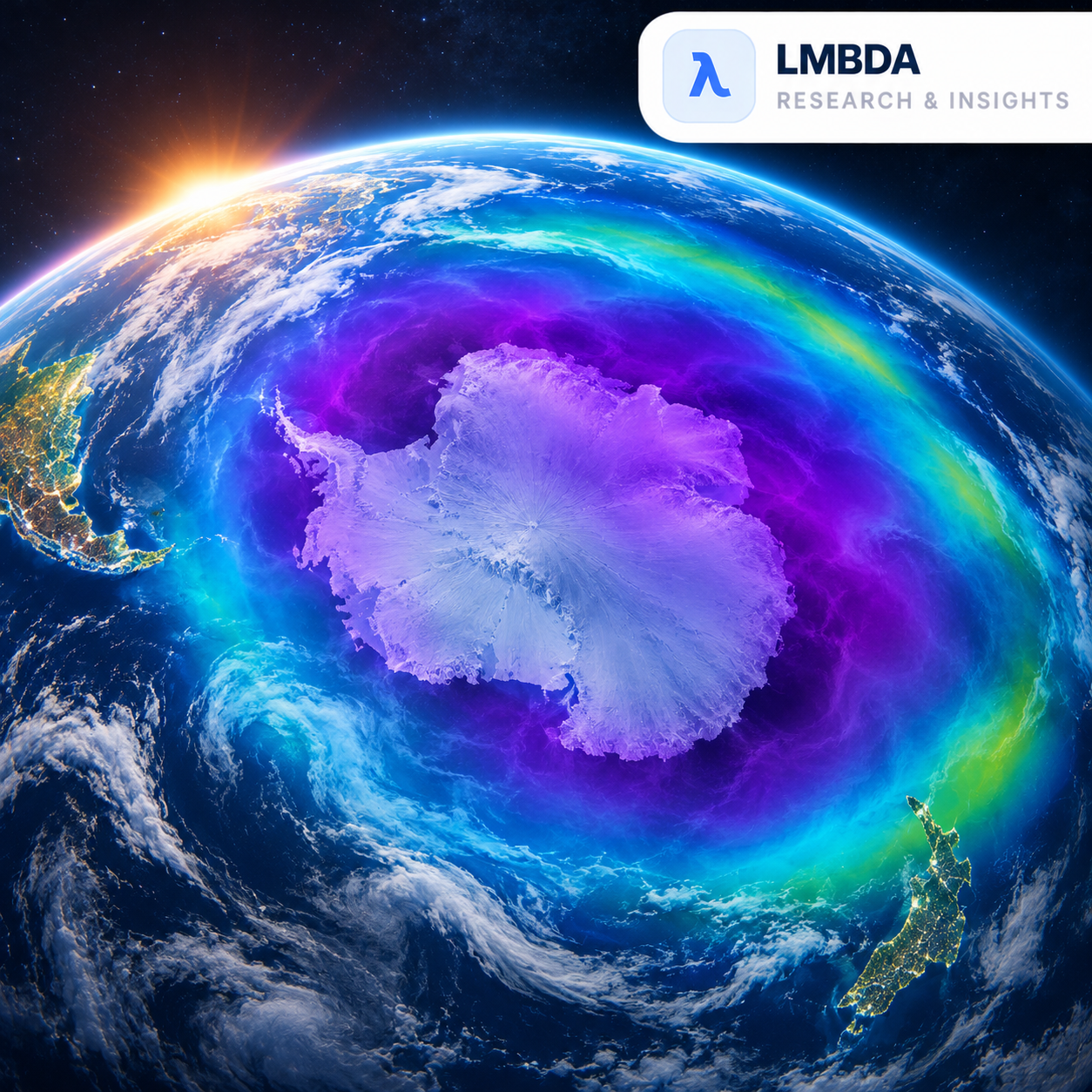
In an update published on November 9, NASA Earth Observatory showed the hole on September 18, the date it reached its largest one-day extent. A separate NASA–NOAA report issued November 4 quantified that peak at approximately 27.1 million square kilometres (10.5 million square miles). Averaged over the September 7–October 13 peak-depletion period, the area was about 25 million square kilometres (9.6 million square miles). These are two different measurements and should not be confused.
What NASA observed in 2026
Scientists define the Antarctic ozone hole as the region where total atmospheric ozone falls below 220 Dobson units, a measure of the amount of ozone in a column of air. The term “hole” does not mean that ozone has disappeared entirely; it describes severe seasonal thinning in the stratosphere above Antarctica.
The 2026 season stood out because the hole spread across an unusually large area. NASA and NOAA ranked it seventh by average area over their 48-year monitoring record. It was not, however, among the deepest holes recorded. NOAA balloon measurements above the South Pole reached a seasonal low of 105 Dobson units on October 17, compared with the South Pole's historical minimum of 92 Dobson units in October 2006.
That distinction is essential: area measures how far ozone depletion spreads; depth measures how low ozone concentrations fall. A season can be exceptional in one dimension without setting a record in the other.
Why the ozone hole grew so large
NASA and NOAA attribute the exceptional 2026 extent primarily to an unusually strong and persistent Antarctic polar vortex. This circulation pattern isolates cold air over the continent. When the stratosphere remains sufficiently cold, conditions favour chemical reactions involving chlorine and bromine that destroy ozone after sunlight returns in the Antarctic spring.
NOAA scientist Amy Butler explained that planetary-scale atmospheric waves, which often disrupt the polar vortex, were comparatively weak during August and September. The resulting circulation allowed cold, ozone-depleting conditions to cover a larger area than usual.
This is a meteorological explanation for the season's unusually large extent, not evidence that emissions of banned ozone-depleting chemicals suddenly returned to their historical peak.
Is the ozone layer recovering or getting worse?
Both statements—“the 2026 hole was very large” and “the ozone layer is recovering over the long term”—can be true. The seasonal hole responds to year-to-year changes in stratospheric weather, while recovery depends largely on the gradual decline of human-produced ozone-depleting substances.
Chlorofluorocarbons and related chemicals were once common in refrigeration, air conditioning, aerosols and industrial applications. In the stratosphere, sunlight can break them down and release reactive chlorine. Bromine-containing compounds also contribute to ozone destruction.
The 1987 Montreal Protocol established international controls on the production and consumption of many ozone-depleting substances. These chemicals are long-lived, so the atmosphere responds slowly. NASA and NOAA say the Antarctic ozone layer remains on a recovery trajectory, with a return toward 1980 conditions expected in the 2070s.
NASA scientist Paul Newman estimated that the 2026 hole could have been approximately 1–2 million square miles larger if ozone-depleting substances had remained as abundant as around their peak in 2000. That is a model-based counterfactual, not an additional area directly observed in 2026.
How scientists measure the ozone hole
Satellite observations have provided a long-running record since 1979. NASA Earth Observatory's historical visualisations combine measurements from successive instruments, including the Total Ozone Mapping Spectrometer (TOMS), the Ozone Monitoring Instrument (OMI) and the Ozone Mapping and Profiler Suite (OMPS). For 2026, the Earth Observatory series uses OMPS data from NOAA-20.
Ground-based instruments and balloon-borne ozonesondes add independent observations of ozone profiles and concentrations. This combination helps scientists assess both the hole's horizontal extent and the amount of ozone remaining above specific locations.
Because the observing systems and atmospheric conditions vary, comparisons require consistent definitions. NASA's headline ranking refers to the average area during the September 7–October 13 peak season, not simply the largest outline visible on one satellite map.
How 2026 compares with previous decades
The ozone hole expanded rapidly during the 1980s and early 1990s as ozone-depleting substances accumulated in the atmosphere. The historical record also contains years with unusually shallow or small holes because of changes in stratospheric circulation.
NASA Earth Observatory identifies 1994 as the year of the deepest hole in its historical minimum-ozone series, with a low of 73 Dobson units on September 30. That historical minimum is not the same metric as NOAA's South Pole-specific balloon minimum of 92 Dobson units in 2006. Different spatial and observational definitions explain why these figures should not be presented as contradictory records.
The largest single-day extent and the largest seasonal-average area are also distinct metrics. NASA's November 2026 reporting gives the 2026 one-day peak and its seventh-place ranking by seasonal average. A single year's map cannot establish the direction of the multidecade recovery trend.
What the ozone hole means for people and ecosystems
Stratospheric ozone absorbs much of the Sun's biologically harmful ultraviolet radiation. Severe depletion can increase UV exposure under affected conditions, creating risks for human skin and eyes and for plants and marine ecosystems.
The Antarctic ozone hole is a seasonal stratospheric phenomenon centred on the polar region. It should not be confused with ground-level ozone, which is an air pollutant, or with climate change, which involves different atmospheric processes even though the systems interact.
For individuals, practical sun protection should follow local UV forecasts rather than assumptions based on the annual size of the Antarctic ozone hole. A large Antarctic hole does not mean that UV exposure is uniformly extreme everywhere on Earth.
What happens next?
NASA and NOAA will continue tracking daily ozone concentrations, seasonal hole area and atmospheric temperatures. Researchers will compare 2026 against the long-term record to separate short-term meteorological variability from changes linked to declining ozone-depleting substances.
The key indicators to follow are the timing of the hole's seasonal formation and breakup, its average area during peak depletion, minimum ozone concentrations and longer-term measurements of stratospheric chlorine and bromine. No single indicator captures the whole recovery story.
Readers can inspect updated satellite maps and historical data through NASA Ozone Watch, including annual statistics and daily Antarctic maps.
Frequently asked questions
How big was the Antarctic ozone hole in 2026?
Its greatest one-day extent was approximately 27.1 million square kilometres on September 18. Its average area from September 7 to October 13 was about 25 million square kilometres.
Was 2026 the largest ozone hole ever recorded?
No. It ranked seventh by average area across 48 years of monitoring. NASA and NOAA also reported that it was not as deep as several major historical holes.
Why was the 2026 ozone hole unusually large?
An unusually strong Antarctic polar vortex maintained cold stratospheric conditions favourable to ozone destruction over a broad region.
What is a Dobson unit?
A Dobson unit measures the total amount of ozone in a vertical column of atmosphere. Scientists commonly define the ozone hole as the area with total ozone below 220 Dobson units.
Does a large ozone hole mean the Montreal Protocol failed?
No. Long-lived chemicals and atmospheric weather variability mean recovery is gradual and uneven. NASA and NOAA say the long-term recovery remains on track.
When will the Antarctic ozone layer recover?
NASA cites an approximate return to 1980 conditions in the 2070s. This is a scientific projection, not a guaranteed date for the disappearance of every seasonal ozone hole.
Where can I see the original NASA data?
NASA Earth Observatory provides the 2026 visualisation and historical comparisons. NASA Ozone Watch publishes monitoring maps, statistics and downloadable data.
Conclusion: a large seasonal hole within a long recovery
The 2026 Antarctic ozone hole demonstrates how strongly the atmosphere's annual behaviour can respond to unusual circulation patterns. Its seventh-place ranking by seasonal area is scientifically significant, but it does not overturn the broader evidence that international controls on ozone-depleting chemicals are helping the stratosphere recover.
The most accurate reading of the data is neither complacency nor alarmism: the hole remained large, the polar vortex amplified depletion, and long-term chemical recovery continues. Monitoring both seasonal extremes and multidecade trends is essential to understand what is changing.