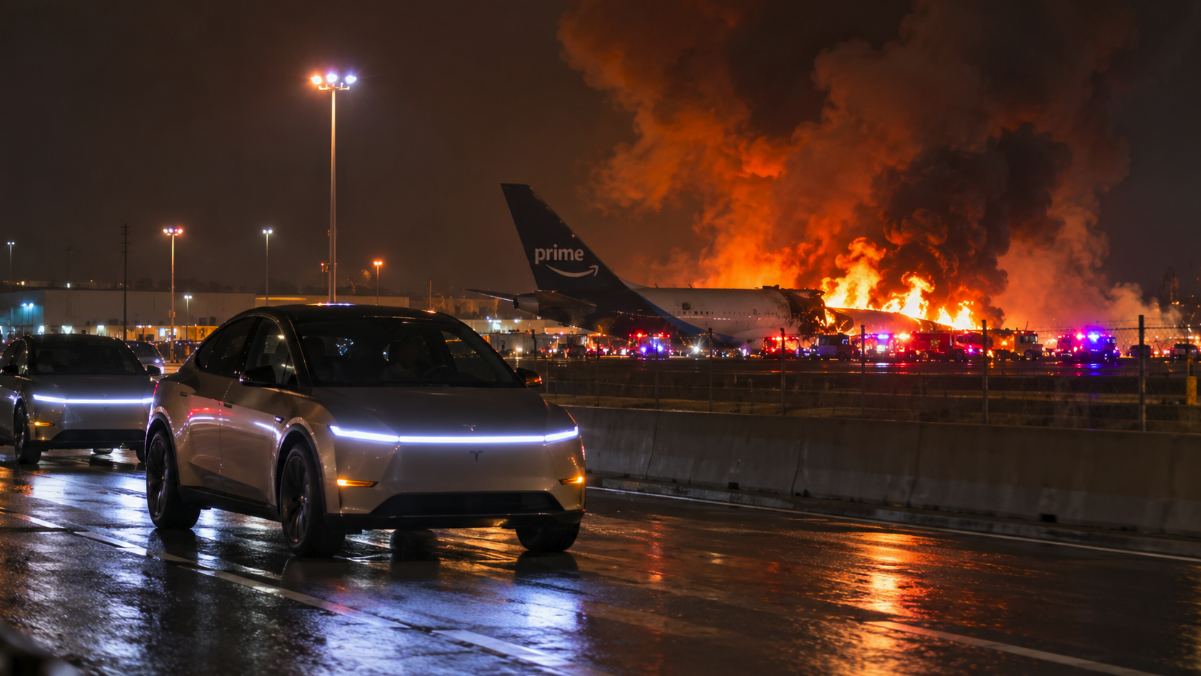
A deadly Amazon Prime Air cargo-plane accident at Miami International Airport produced an extraordinary image: the wreckage of a Boeing 767 resting close to a staging area containing dozens of Tesla Cybercabs. The proximity of Tesla's new steering-wheel-free robotaxis quickly became a social-media talking point, but the vehicles were bystanders in a much more consequential aviation accident.
The Boeing 767-300, operated by 21 Air for Amazon's Prime Air network, overran Runway 30 on September 6 after arriving from San Juan, Puerto Rico. According to Reuters, citing the National Transportation Safety Board, the aircraft traveled roughly 1,300 feet beyond the runway, struck airport equipment and vehicles and killed five people on the ground. Five others were injured. The two pilots survived.
Images from the scene showed the aircraft coming to rest near a group of Tesla Cybercabs. That visual coincidence explains why a fatal aviation accident became entangled with one of the technology industry's most closely watched autonomous-vehicle launches. It does not, however, mean the Cybercabs played any role in causing the accident, and investigators are focused on the aircraft, landing and airport environment.
The investigation is about the Boeing 767 and the runway
The NTSB has recovered both the cockpit voice recorder and flight data recorder and deployed a large investigative team to Miami. Chair Jennifer Homendy described the scene as one of extensive devastation. Investigators are examining the aircraft's performance, its approach and landing, the condition of its systems, weather and other operational factors. The cause has not been determined, and early observations about speed or touchdown position should not be treated as final conclusions.
Associated Press reporting says investigators are looking at whether the jet touched down too far along the runway to stop safely and whether the crew should have executed a go-around. Video evidence is part of that inquiry, while the recovered flight recorder should provide much more precise information about speed, braking and aircraft configuration.
Another issue receiving scrutiny is the absence of an Engineered Materials Arresting System, or EMAS, at the end of the runway. EMAS uses crushable material designed to slow an aircraft that overruns pavement. Miami International Airport's runway nevertheless met applicable safety requirements with its existing runway-safety area, according to reporting on the investigation. Whether an arresting system could have changed the outcome is therefore an investigative question, not an established finding.
Why were Cybercabs sitting near Miami airport?
The unusual secondary story is the presence of Tesla's newest vehicle. The Cybercab is a purpose-built autonomous two-seater without a conventional steering wheel or pedals. Tesla launched public Cybercab rides in Austin days before the Miami accident, making the vehicle's appearance beside the wreckage particularly conspicuous.
The Miami vehicles were not evidence that Tesla had launched a Cybercab passenger service at the airport. Teslarati reported that the cars were in a fenced staging area and that Tesla and airport officials had not publicly explained the fleet's presence. Images show the aircraft stopped extremely close to the area, but authorities had not established that Cybercabs themselves were struck.
The distinction is important because dramatic photographs can imply a connection that the evidence does not support. The cargo jet did strike vehicles during the overrun, with the fatalities occurring among people on the ground. The nearby Tesla fleet appears to have been an extraordinary coincidence rather than a factor in the crash.
The coincidence arrived at a sensitive moment for Tesla
Cybercab had already become a regulatory story before the aircraft accident. The Associated Press reported that the U.S. National Highway Traffic Safety Administration opened an inquiry into how Tesla certified the unconventional vehicle under federal motor-vehicle safety standards. Because Cybercab dispenses with familiar controls including a steering wheel and brake pedal, its compliance pathway is receiving particular attention.
That inquiry is separate from the Miami accident. The NHTSA question concerns vehicle certification and Tesla's autonomous-vehicle rollout; the NTSB investigation in Miami concerns an aircraft runway overrun. Their overlap is visual and temporal rather than causal.
The timing nevertheless illustrates how quickly Tesla's Cybercab has moved from a futuristic prototype into real-world infrastructure. Once autonomous vehicles are deployed in meaningful numbers, they will increasingly appear in the ordinary—and occasionally extraordinary—background of urban events. A fleet sitting beside an airport runway can suddenly become part of a global news image even when the technology itself has nothing to do with what happened.
A striking image should not distract from five deaths
Elon Musk reacted to a social-media post about the proximity of the Cybercabs with the word “Weird,” according to Teslarati. It was an understandable description of the coincidence, but the more important story remains the loss of life and the investigation into how a large cargo aircraft traveled beyond the airport boundary and into occupied vehicles.
The flight recorders should give investigators a detailed reconstruction of the final approach, touchdown and overrun. Investigators will also examine aircraft systems, crew actions, runway conditions and airport safeguards before reaching conclusions. Aviation accident investigations are deliberately methodical, and definitive causal claims made before that evidence is analyzed risk getting ahead of the facts.
For Tesla, the episode may ultimately amount to little more than an unsettling photograph of its newest vehicles narrowly adjacent to a major accident scene. For aviation, the questions are much larger: why the aircraft could not stop, whether the landing should have been abandoned earlier, and whether additional runway-overrun protection might have reduced the consequences. Those answers, rather than the unlikely appearance of Cybercabs beside the wreckage, will determine what changes after Miami.